


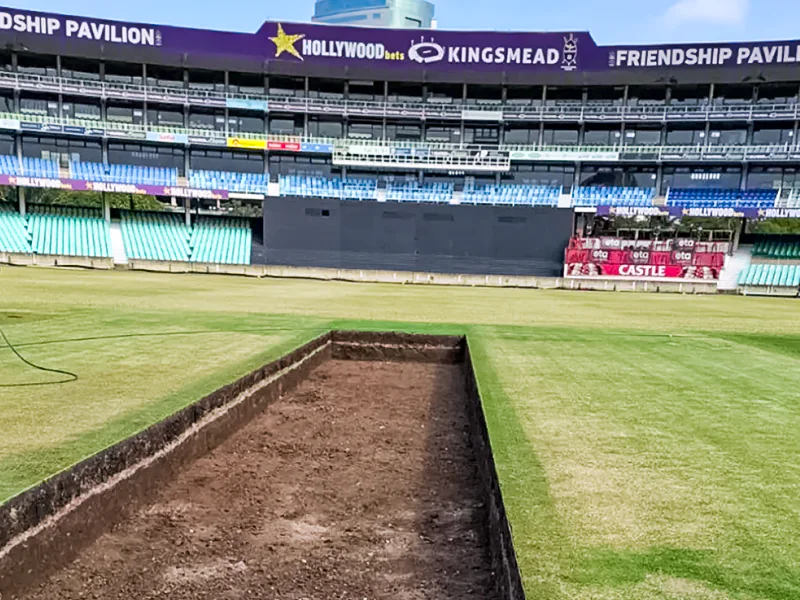
South Africa will stage more cricket this season than ever before with 78 matchdays scheduled across men’s and women’s international games, more domestic first-class matches since the system was restructured five years ago, an expanded provincial T20 tournament (a fast-paced cricket competition where each team plays a single innings limited to a maximum of 20 overs) that includes 71 matches and the SA20 (South Africa’s premier franchise Twenty20 [T20] cricket league) and it’s a sign of things to come.
Heavy Workload
‘cricinfo’ stated that while every summer may not have as many as the 10 Tests (eight Men’s and two women’s) this one has, the increase in short-format games and women’s fixtures, in particular, has put the country’s major grounds and pitches under an extremely heavy workload.
Exchangeable Pitch System
There’s talk of tracks aging, slowing down or behaving inconsistently for which Cricket South Africa (CSA) have invested in a medium- and long-term solution: EPS, the exchangeable pitch system.
The possibilities the Exchangeable Pitch System (EPS) offers bode well for a busy future and South Africa are basking in the knowledge that they created it themselves.
Swap Surfaces
‘cricinfo’ further stated that unlike in Australia, where the pitches are dropped in to play cricket and then taken out for other sports, South Africa are pioneering a different method. Their busier stadiums will have surfaces they can swap in and out as needed without having to relay entire squares or take grounds out of circulation for extended periods of time.
New Pitches
Informed Hilbert Smit, Cricket South Africa’s longtime Pitch Consultant, “In South Africa, we haven’t really installed new pitches for many years, because we can’t. We can’t just take one of the pitches out for a season because that will reduce capacity and we just don’t have that luxury. So, we are introducing an exchangeable pitch system and we don’t want to call it drop-ins because that’s not what it is.”
Good Bounce
The natural qualities of the South African pitches, which typically offer good bounce and carry, will be retained or even enhanced with the creation of new pitches which are prepared in steel trays on the outfield, independently of the square.
Turf Side
Added Smit, “On the turf side there is absolutely nothing different to building a new pitch. It’s your fertility levels, it’s moisture content and then just planting the grass and growing it. The difference is that these pitches are being built in a confined area. They are not interacting with what happens next door with the other turf and with Mother Earth, so now you can control it better.”
Pitch Timeline
The full process, from planting to producing a pitch ready to be put into the square, takes 18 months and the timeline will be strictly followed.
Six Venues
So far, six venues, all SA20 hosts (The 34,000-seat Wanderers Stadium in Gauteng, the 25,000-seat Kingsmead Cricket Ground in Durban, the 25,000-seat Newlands Cricket Ground in Cape Town, the 19,000-seat St George’s Park Cricket Ground in Gqeberha, the 10,000-seat Boland Park in Paarl, and the 22,000-seat SuperSport Park in Centurion) have agreed to participate in the exchangeable pitch system.
Test Matches
None of the exchangeable pitches will be used for Test matches at the moment and it is understood that only the Wanderers, whose pitch has been in the square for the last year, may use their exchangeable for the 2027 ODI World Cup. The Wanderers could also be the first to use their exchangeable pitch for the SA20 with talks in place for the upcoming season. The other grounds will begin testing out their exchangeable pitches in domestic matches this season with the exception of the SuperSport Park, who will wait until after the World Cup to put their exchangeable in.
‘White-ball Solutions’
The exchangeable pitches have been designed as what Evan Flint (former Newlands and Wanderers groundsman who now works two days a week as a consultant at Kingsmead) called “white-ball solutions” though even the 2027 World Cup is too soon for most grounds and the CSA are intent on playing the long game.
‘Growing Process’
Stated Smit, “If you rebuild a new pitch in the middle of the square we have found 18 months minimum before you use it. If you build it now and grow it outside there’s no interference now in this growing process so it could be quicker.”
‘Speeds Up’
Both Smit and Flint agree that anything less than 12 months would not be risked and with Newlands, Kingsmead, Paarl, and St George’s Park at the cusp of that the World Cup will likely be played on the already-existing surfaces. But, in the long term, the exchangeables will be used with frequency, especially once the process of getting them in and out speeds up.
Air Cushion
The exchangeable pitch weighs 32 tonnes and is moved on a hovercraft principle on a truck. An industrial fan generates air which creates an air cushion under the pitch tray making it as light as two or three tonnes. Then, once it reaches its position on the square the air cushions (or pontoons) are used to lift the pitch tray up and then down.
Double Ground Usage
Once an exchangeable pitch is in it needs between five and six days on the square before it can be played on. Then it can be used for the usual five to eight days of high-level cricket in the summer and swapped out to essentially double a ground’s usage. This is how Flint sees it potentially playing out: “Let’s use the SA20 as an example. You would go into the SA20 with a fresh, fully grassed wicket that’s ready to play three to four matches on it in the SA20, and then at the end of the SA20 you would exchange it for the one that’s on the edge of your field and you would bring that one in for either your international, maybe an ODI or a T20I or even a domestic match which is televised and you won’t be going back to that used surface. One-day international or a T20, or even domestic men’s matches which are televised. At least you’re not then going back to that used surface. You’ve got now a fresh surface that’s been rehabilitated on the edge of the field and it’s essentially almost like a brand-new pitch halfway through your season.”
The 2027 ICC Men’s Cricket World Cup will be the 14th edition of the Cricket World Cup, the quadrennial international Men’s cricket championship contested by the national teams of the member associations of the International Cricket Council (ICC). It is scheduled to be played in South Africa, Zimbabwe and Namibia from October 2nd-November 21st, 2027.
Continue following Coliseum for the latest updates on sports venues, stadiums and arena business news worldwide.
Coliseum is dedicated to building a global community of sports and entertainment venue professionals helping create better and more profitable venues.
Become a member of the Global Sports Venue Alliance and connect with stadiums, arenas and industry experts from around the world. Apply for membership through the Global Sports Venue Alliance and access the 365Coliseum Business platform.