


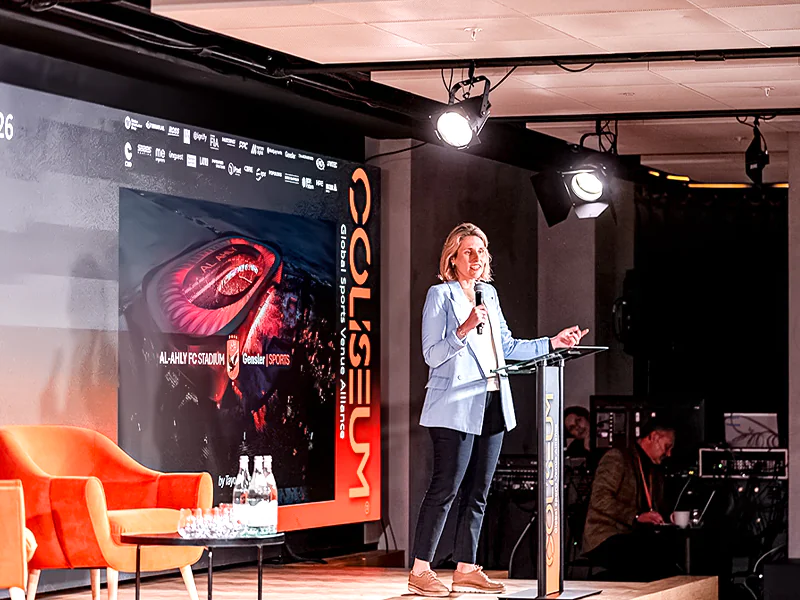
Tayomara Gama is Head of Sports and Live Music Entertainment at architecture firm Gensler, with a remit covering Europe, the United Kingdom and markets beyond the region. Her work focuses on the transformative potential of sports architecture and the creation of experience-led environments that promote equity, resilience and well-being.
In a conversation with ‘Coliseum’, Tayomara Gama, MAPM Sports & Entertainment Lead, Europe, Gensler, UK, discusses the long-awaited new home of Egyptian Premier League giant Al Ahly SC – the Vodafone Stadium in Greater Cairo, Egypt.
Describing the project as “30 years in the making”, Gama explains how Gensler, the lead architectural design firm for the stadium, has had to respond to a series of unusual site and design constraints.
“Apart from the site constraints of Al Ahly SC’s Vodafone Stadium, the design process can look very easy. But how you resolve the architecture through unique solutions is where the real work happens. That is what we did, and how we overcame the design challenges.”
Gensler
San Francisco (US)-based Gensler is a global architecture, design and planning firm. Its work is guided by a mission to create a better world through the power of design, with a focus on how the built environment can contribute to greater equity, resilience and well-being.
Vodafone Stadium
Al Ahly SC’s new home, the 42,000-seat Vodafone Stadium in Sheikh Zayed City within the Greater Cairo area, is currently under construction and is expected to be completed around 2029.
Physical construction of the new stadium began in February 2025, following the development of the project with Gensler as lead architect. The description of the stadium as “30 years in the making” refers to Al Ahly’s long-standing ambition to develop a dedicated home of its own – an ambition stretching back to the mid-1990s – rather than to the duration of the construction programme itself.
Al Ahly SC
Al Ahly SC is a professional sports club based in Cairo, Egypt, best known internationally for its football team competing in the Egyptian Premier League, the country’s top division. With an extensive domestic and continental honours list and a vast supporter base, Al Ahly is one of the most successful and widely followed football clubs in Africa. The team currently plays its home matches at the 75,000-capacity Cairo International Stadium.
‘Impactful Design Firm’
Gama began the conversation by outlining Gensler’s scale and approach to collaboration.
“Gensler is one of the most impactful design firms globally, with nearly 7,000 designers. We don’t have engineers, so we partner with the best – as we are doing on the Al Ahly SC stadium project with British professional services firm Buro Happold. We have grown organically over the last 60 years.”
‘Embracing Challenges’
For Gama, the constraints surrounding the Al Ahly project became an important part of the architectural response rather than simply obstacles to overcome.
“In the case of Al Ahly SC’s new venue, it is all about recognising the challenges and embracing them. The Al Ahly Stadium has been 30 years in the making, and the Gensler approach was: ‘Maybe your challenge is your solution.’ We did not simply try to give them a solution.”
The overriding objective, she explains, was to create the Ultimate Stadium Experience while translating the scale and intensity of Al Ahly’s support into the architecture.
“Al Ahly SC has a really large fanbase – around 40 million followers. It was therefore about understanding the different kinds of fans, how the new facility will influence them, what its legacy will be, and how you translate that passion and pride into design.”
Master Plan Project
The Vodafone Stadium is conceived as much more than an isolated football venue. It forms the catalyst for a wider master plan intended to establish a new sports, leisure and community destination.
“The Vodafone Stadium is actually a master plan project – it goes beyond the stadium. The venue is near Cairo, between Cairo and Alexandria on the motorway, and provides a getaway from the city near Giza, not far from the Pyramids.”
Its strategic location was an important consideration in the planning process.
“Some 70 to 75 percent of the population will pass through this motorway. So, we looked at the stadium as a catalyst for the master plan. There is a planned hotel, an existing leisure centre, as well as a planned school and hospital.”
Design Challenges
The site presented Gensler with a particularly complex combination of climatic, topographical and aviation-related constraints.
“As architects, we did our due diligence. We studied the wind and the sun. It is a very hot location, so the question becomes: How do we design for that? The site constraints really drive the response.”
One of the defining limitations is the stadium’s proximity to an airport, which imposes strict height restrictions across the site.
“Basically, we have a 30-metre constraint because of the airport nearby, around five miles to the northeast, and we have this hard boundary. On the other side, we could build 12 metres. The site is around 185 metres above sea level, but that is an average because the topography descends.”
Rather than allowing those limitations to dictate a compromised solution, Gensler used them to shape the stadium’s architectural identity.
“It is about understanding the design process, starting with the symmetrical bowl and then shaping it, tailoring it and almost sculpting it like a piece of art. The design then evolves. The club started thinking about how to integrate the plaza, and the envelope ultimately became a response to the project’s biggest challenge.”
Façade
The stadium façade has been developed in response to the very different conditions surrounding each side of the building rather than as a uniform architectural skin.
“The façade is about understanding it in different dimensions. The east and north sides of the arena are widely different. The east is where spectators will approach and is much more pedestrian-oriented, while the north faces the motorway.”
That difference in scale also creates different opportunities for visibility and commercial activation.
“On the motorway side, you need more definition and more light. You are designing at a different scale for people travelling by car, while also considering sponsorship opportunities and activation.”
The southeast side, meanwhile, plays a different role in connecting the stadium with its immediate surroundings.
“This is one of the assets beyond the stadium. The southeast side is really where you connect with the community and the residents, and where you consider how to bring that space to them and create connectivity.”
Design Product
For Gama, successful venue architecture must ultimately combine design quality with a sound commercial proposition.
“Good design should also be good business. It is about understanding the different user groups and taking a more bespoke, tailored approach to each client. You then tailor the product accordingly.”
Sum-up
Flexibility
Gama concluded by highlighting flexibility as an essential consideration in contemporary venue design – not as a new concept, but as something that needs to be embedded more effectively into the architecture from the outset.
“The flexibility we talk about all the time is not something new. When we design, we need to create something that can be flexible depending on the content, with different views and different stage configurations.”
While that flexibility can add complexity to the design process, she believes it substantially increases the long-term possibilities for the building.
“It makes the design more difficult, but it gives you more possibilities in the future. It is not only a music venue, or a sports venue, or a couture venue. It should be able to flex between all of them.”
That multidisciplinary thinking, Gama added, reflects Gensler’s broader approach to projects.
“Gensler designs everything from brands and interiors all the way to cities, and I think this is a great example of cross-pollination at Gensler. We have all these different areas of expertise, but we bring to the client what they actually need. Sometimes you may think the solution is in sport, but it might come from hospitality or couture. That is what we can bring to the table.”
Continue following Coliseum for the latest updates on sports venues, stadiums and arena business news worldwide.
Coliseum is dedicated to building a global community of sports and entertainment venue professionals helping create better and more profitable venues.
Become a member of the Global Sports Venue Alliance and connect with stadiums, arenas and industry experts from around the world. Apply for membership through the Global Sports Venue Alliance and access the 365Coliseum Business platform.