


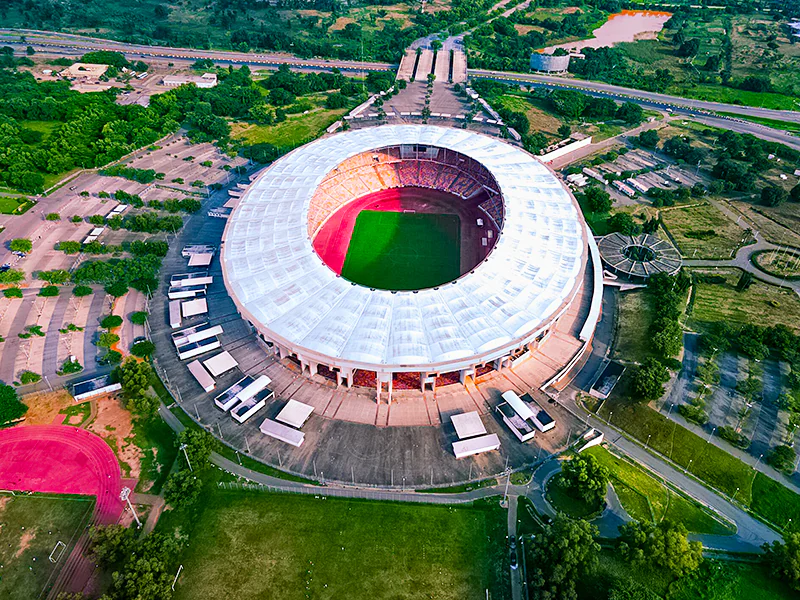
The federal Government has approved a major nationwide sports infrastructure renewal program that will see the rehabilitation of the Moshood Abiola National Stadium in Abuja, Nigeria, and the upgrade of several sporting facilities across Nigeria as part of efforts to reposition the country’s sports sector.
‘PREMIUM Times’ stated that the above announcement represents one of the most ambitious sports infrastructure plans unveiled by the federal Government in recent years.
Built ahead of the 2003 All Africa Games the Moshood Abiola National Stadium has gradually deteriorated over the years with concerns repeatedly raised about damaged facilities, poor playing surfaces, obsolete equipment, and inadequate maintenance culture.
Infrastructure Push
Officials at the NSC say the latest infrastructure push is intended not only to improve sporting performance but also to create jobs, stimulate economic activity and reposition sports as a tool for national development and social cohesion.
The above initiative, announced by the National Sports Commission (NSC) recently, forms part of what officials described as the first phase of a broader sports development agenda aligned with the President of Nigeria Bola Tinubu’s Renewed Hope program.
Total Redevelopment
According to the NSC, the intervention will include the complete rehabilitation and upgrade of the Moshood Abiola National Stadium covering the tracks, the floodlights, the athlete and media facilities, the medical infrastructure, and the training pitches.
The project will also feature the construction of a High-Performance Centre, an anti-doping laboratory, the redevelopment of the stadium’s 200-room athletes’ hostel into a hotel facility, installation of Video Assistant Referee (VAR) technology, and the creation of additional office spaces for the sports federations.
The 60,491-seat Moshood Abiola National Stadium (formerly known as the National Stadium, Abuja) is a multipurpose national sports stadium located in Abuja in the Federal Capital Territory of Nigeria. The stadium serves as the home of the Nigerian national football team as well as a center for various social, cultural and religious events.
The National Sports Commission (NSC) is the apex Governmental body responsible for the development, promotion and regulation of sports and physical fitness across Nigeria. Operating at the national level the commission oversees grassroots talent identification, elite athlete welfare and the advancement of the Nigerian sports economy.
The Renewed Hope program refers to a comprehensive socio-economic development agenda launched by President Bola Tinubu’s administration in Nigeria. It aims to uplift the vulnerable populations, empower the small businesses, construct mass housing, and drive grassroots economic growth through various targeted initiatives.
Sports Boost
‘PREMIUM Times’ further stated that beyond Abuja, the Government said the initiative would extend to the rehabilitation of sports infrastructure across the country, support for the States hosting future National Sports Festivals, the development of elite training facilities, and the construction of mini sports centers nationwide.
The program will also target the tertiary institutions by establishing the sports facilities to strengthen grassroots development and revive school sports.
Renewed Hope Agenda
The National Sports Commission (NSC) stated, “The unprecedented investments which is the first phase align with the Renewed Hope Agenda and shared prosperity vision of President Tinubu and are designed to position sports as a driver of youth empowerment, economic growth, talent development, and national unity.”
Decades of Decay
For decades, poor maintenance, underfunding and the administrative instability have contributed to the decline of several major sporting facilities in Nigeria, including the Moshood Abiola National Stadium, once regarded as one of Africa’s leading sports complexes.
In recent years, the private sector interventions have failed to rescue parts of the country’s sports infrastructure.
In 2021, the billionaire businessman Aliko Dangote, through the Dangote Group (the largest business conglomerate in West Africa), financed the rehabilitation of the Moshood Abiola National Stadium pitch after the facility suffered years of neglect.
Though a reported $1m was spent the intervention only briefly helped restore the playing surface ahead of the international football matches involving the Super Eagles (the Nigerian national football team).
Similarly, veteran businessman and philanthropist Kessington Adebutu also made donations to restore the 45,000-capacity National Stadium in Lagos (Nigeria) to its former glory under the Adopt-a-Pitch initiative (a public-private partnership launched by the Nigerian Federal Ministry of Youth and Sports Development. It was designed to rescue abandoned sporting infrastructure across the country) but the facility remains a shadow of its former self.
Urgent Intervention
The key figures in the sports industry have long argued that the meaningful infrastructure investment remains critical to Nigeria’s sporting ambitions especially as the country seeks to improve athlete preparation, host international competitions and strengthen sports as an economic sector.
Currently, Nigeria, with over 150 million people, has only one FIFA-approved pitch, the 30,000-capacity Godswill Akpabio International Stadium.
The planned establishment of a High-Performance Center and the anti-doping laboratory is also expected to address longstanding gaps in elite athlete development and Sports Science support.
Nigeria has historically relied on the overseas facilities for some advanced sports medicine and anti-doping processes, a situation many experts believe has limited athlete preparation and international competitiveness.
The proposed nationwide mini sports centers and the tertiary institution projects are equally seen as attempts to revive the grassroots sports development which has suffered a sharp decline since the collapse of structured school sports competitions that once produced generations of Nigerian athletes.
Continue following Coliseum for the latest updates on sports venues, stadiums and arena business news worldwide.
Coliseum is dedicated to building a global community of sports and entertainment venue professionals helping create better and more profitable venues.
Become a member of the Global Sports Venue Alliance and connect with stadiums, arenas and industry experts from around the world. Apply for membership through the Global Sports Venue Alliance and access the 365Coliseum Business platform.