


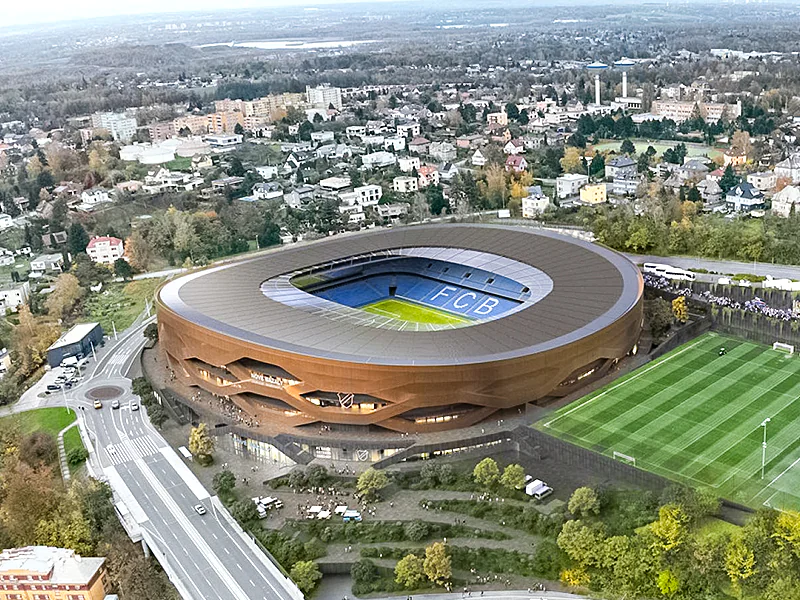
Ostrava (Czech Republic) councilors have approved a contract to create project documentation for the New Bazaly football stadium.
Homecoming
Bazaly was the Czech First League team FC Baník Ostrava’s traditional home ground and the new stadium is intended to allow the club to return to the place with which it was historically associated. The players had to move to the Municipal Stadium in Ostrava-Vítkovice (Czechia) because their traditional ground no longer met the required conditions. The city has repeatedly described the functioning of the football players and the athletes in a shared facility as quite problematic and unsustainable in terms of capacity.
Building Permit
‘sport.ceskatelevize.cz’ stated that the city wants to have a building permit within two years. The project documentation should cost approximately 273 million crowns. It will be prepared for the city by the L35 Arquitectos studio from Barcelona (Spain) which won the design competition.
The New Bazaly Stadium is a planned 20,000-capacity football stadium in Ostrava, Czech Republic, designed to return the Czech First League team FC Baník Ostrava to its historic home ground in Slezská Ostrava (Czechia). Selected as the winning design in November 2025 the project by architecture studio L35 Arquitectos replaces the former Bazaly stadium (which Baník Ostrava left in 2015) and has an estimated cost of around CZK 2.5 billion with construction targeted to begin around 2029.
The FC Baník Ostrava is a professional football club from Ostrava in the Czech Republic. The club competes in the Czech First League, the top tier of Czech football.
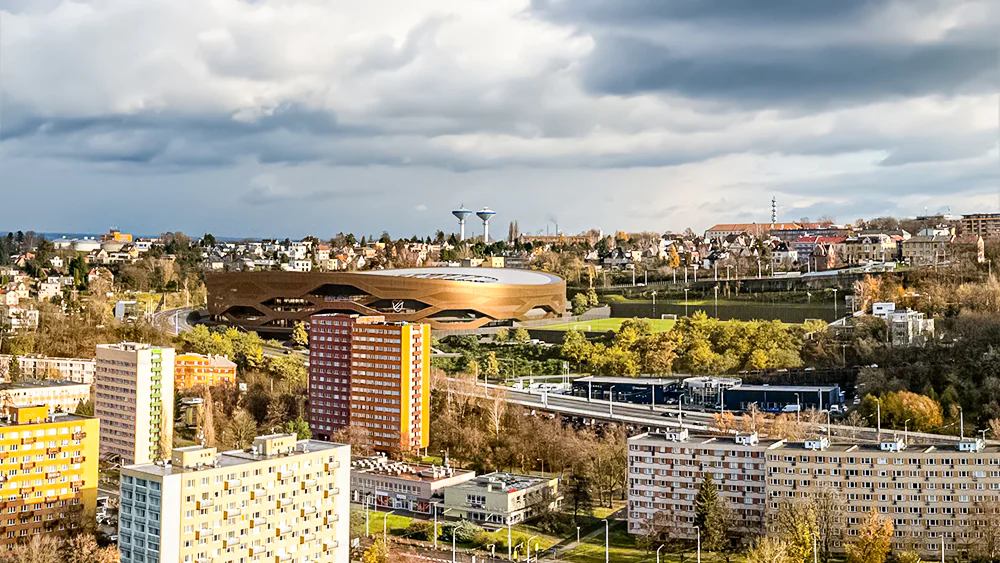

The Městský stadion v Ostravě-Vítkovicích (‘City Stadium in Ostrava-Vítkovice’) is a multipurpose stadium in Vítkovice, district of Ostrava, Czech Republic. Used primarily for football it is the home stadium of the FC Baník Ostrava. The stadium holds 15,123 spectators.
Barcelona (Spain)-based L35 Architects is an international architecture, urbanism and design firm. Founded in 1967, L35’s practice covers a myriad of architectural forms and projects, both large and complex, among which are several office buildings and the corporate headquarters, the residential complexes, the large shopping and leisure centers, the mixed-use developments, the sports stadiums, and the urban developments.
Project Documentation
‘sport.ceskatelevize.cz’ further stated that the Mayor of Ostrava Richard Vereš (ANO) and the Deputy Mayor of Ostrava Lukáš Semerák (Ostravak) will work in sync with the several companies from Europe in creating the documentation. The city estimates that the entire project will cost around five billion.
‘Climatic Comfort Study’
Stated Semerák, “The contract is basically structured into several parts. It is a basic design but the various parts could not be the subject of an architectural competition. The largest item there is the interiors with the furniture, but also, for example, a study of crowd management in the stadium and in front of the stadium or a study of climatic comfort or a test in a wind tunnel.”
External Partners
The city originally estimated that the construction of the stadium would cost circa 2.5 billion. According to Mayor Vereš, however, this was only the construction cost and he currently estimates the cost of the entire project to be twice as much. The cost of the design work has also increased. However, the city would like to build the stadium in cooperation with the external partners.
Financing Models
Semerák informed that various surveys will be completed in the next 15 weeks and then the design exercise will begin. The documentation should be completed within two years. By that time the city management wants to have a clear plan in place for financing the construction. There are two models.
Private Sector Involvement
Outlined Mayor Vereš, “One is the involvement of the external sources, that is, either the State or the European subsidies. We have also been promised a contribution from the region, we can talk about increasing it. And the second option is the involvement of the private sector which is the preferred option for me.”
He believes that the city would be able to cover about half of the stadium build costs.
Sustainability Factor
The stadium is designed for approximately 20,000 seated spectators. The building is to be built on the same site where the first-league Baník Ostrava played from 1959 to the 2014-2015 seasons. The new stadium, which will be able to hold the international matches, including the national team matches, will be certified according to the BREEAM standard (sustainability of buildings). It will include a football club museum and other attractions, restaurants and fan shops. The stadium will remain open on days even when the football matches are not played.
From 1959 to the end of the 2014-2015 seasons the FC Baník Ostrava played their home matches at Bazaly, a football stadium located in the Slezská Ostrava district of Ostrava, Czech Republic.
Continue following Coliseum for the latest updates on sports venues, stadiums and arena business news worldwide.
Coliseum is dedicated to building a global community of sports and entertainment venue professionals helping create better and more profitable venues.
Become a member of the Global Sports Venue Alliance and connect with stadiums, arenas and industry experts from around the world. Apply for membership through the Global Sports Venue Alliance and access the 365Coliseum Business platform.