


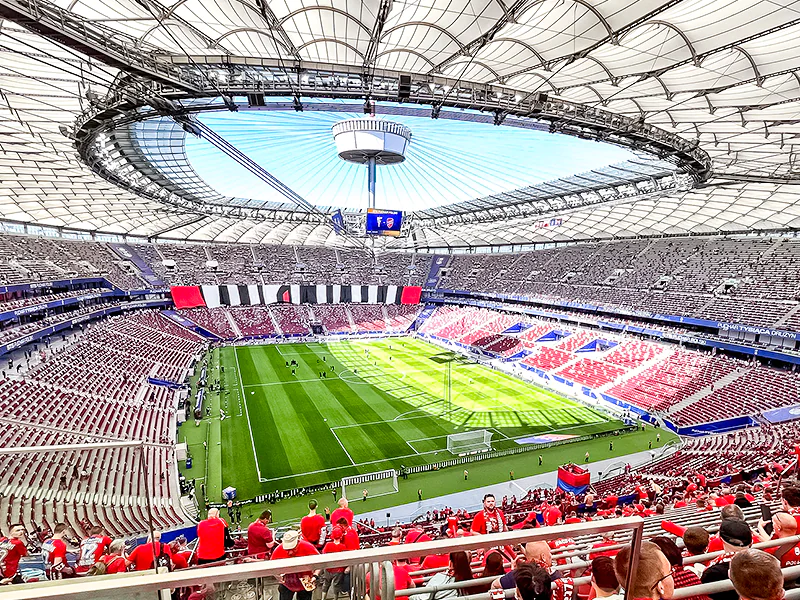
Efforts are on to modernize the National Stadium in Poland to meet Olympic standards so that the venue can host the greatest sporting extravaganza on the planet in the future.
‘przegladsportowy.onenet.pl’ stated that as per the National Stadium’s Chief Designer Mariusz Rutz of JSK Architekci modernizing the facility for the Olympics is a more cost-effective option than building a new arena. The initial analyses include expanding the stands to 80,000 seats and building athletics track which could be dismantled after the Games.
According to Rutz, the Ministry of Sport and Tourism some time back approached the JSK Architekci with a request for a preliminary presentation as regards the possibilities of modernizing the National Stadium in Warsaw (Poland) which would be adapted to the standards of a facility which meets the benchmarks of organizing the Olympic Games.
The 58,000-plus capacity Stadion Narodowy, also known as the National Stadium, and known for sponsorship reasons as the PGE Narodowy since 2015, is a retractable roof football stadium located in Warsaw, Poland. It is used mostly for concerts and football matches and is the home stadium of the Poland national football team.
Olympic Stadium
Remarked Rutz, “There are technical possibilities to revamp the current National Stadium in Poland for the Olympics. The first step is to install an athletics track. This can be done but it would require the removal of the first few rows of seats.”
‘przegladsportowy.onenet.pl’ further stated that another factor is the expansion of the stands. In this case, Rutz indicated that it would require the removal of the roof and then building additional seating sections on additional suspended pillars – “Building an additional grandstand would increase the facility’s capacity by approximately 35,000 seats. These are the current standards. The roof could still be closed when the grandstand is added but that decision lies in the court of the investor.”
UEFA Benchmark
Rutz mentioned that when designing the National Stadium, which was built for the 2012 European Football Championship, the Union of European Football Associations (UEFA) capacity recommendation was a minimum of 55,000 people. This figure did not include the newsmen. If the total redesigning of the facility takes place it will be able to accommodate 80,000 fans.
Added Rutz, “However, there’s one more thing to remember which I strongly recommend. The National Stadium in Poland is a facility designed specifically for the football events. Therefore, after the Olympics, the athletics track would be dismantled.”
The architect stated that the 80,000-capacity of the venue would remain unchanged and will be in a position to host the Champions League Final which is currently nigh impossible.
Nyon (Switzerland)-based the Union of European Football Associations (UEFA) is the governing body of football in Europe uniting 55 national associations and overseeing the promotion, regulation and development of the sport across the continent.
The UEFA Champions League, commonly known as the Champions League, is an annual club association football competition organized by the UEFA that is contested by the top-division European clubs.
Design Process
Rutz estimates that the design process alone could take up to two years. The next step is selecting a contractor through the tender exercise followed by the actual construction process per se which, he estimates, could take about two years. During the grandstand expansion and construction of the new roof events on the stadium field would remain suspended. However, the use of the spaces beneath the grandstands will remain largely possible during the construction period.
Price Tag
Rutz did not provide a clear picture on the costs that the modernization would entail – “I am convinced that the modernization option is much cheaper and more cost-effective than building a new facility dedicated solely to the Olympic Games. It’s important to remember that the cost of building a new facility alone will be enormous and that’s not all. In my opinion, a more important issue is the fact that maintaining two such large facilities in Warsaw would not be economically viable.”
Precision Planning
Drawing up the modernization plans for the PGE Narodowy Stadium would require precision planning as the venue is bustling with activities the whole year through and various events are planned well in advance.
Operating Schedule
Maintained Małgorzata Bajer, Director of Communications, Promotion and Marketing, PL.2012+, “The PGE Narodowy Stadium is operating according to a specific schedule. The small-scale events such as the trade fairs, the conferences and the congresses as well as the concerts, the matches, the drifting competitions, and the speedway events are being carried out on an ongoing basis and planned for the coming years.”
She also noted that the facility’s operating schedule is adapted to the current needs of the stadium including the scope of planned renovation works.
Currently, the facility operator has no plans to suspend bookings or cancel the organization of events in the coming years.
At the same time, she pointed out that the operator of the PGE Narodowy Stadium, which hosts major sporting and cultural acts, fully supports the idea of organizing the Games in Poland, and if this were to happen, the stadium should hold major Olympic events.
Added a spokeswoman for the facility, “We are convinced that an event of this rank and scale should be held at the PGE Narodowy Stadium, a facility of particular significance to all Poles. We declare our full readiness and commitment to working towards this goal. Should modernization or renovations be necessary the venue’s events calendar will be adjusted according to the work schedule.”
The National Stadium was built on the site of the famous Tenth Anniversary Stadium built during the Polish People’s Republic for the Warsaw Youth and Students Festival in 1955. The initial construction work began in September 2008 and was completed on November 30th, 2011, although the original plans assumed much earlier dates.
The facility, built for the 2012 European Football Championships, which Poland co-hosted with Ukraine, can accommodate 58,000 spectators. The stadium officially opened on January 29th, 2012, and the first match – a friendly between Poland and Portugal – was played on February 29th, 2012. The price tag of building the arena was circa PLN 2 billion.
In 2015, the energy company PGE became the stadium’s title sponsor and the facility changed its name to PGE Narodowy. Since 2021, it has also been named after the legendary football coach Kazimierz Górski.
So far, the Polish national football team has played 49 matches there winning 29, drawing 13 and losing seven.
The Speedway Grand Prix competitions are regularly held in the arena – on a temporarily covered track – although this year they will be replaced by the final tournament of the Team World Cup.
The music concerts are also held annually. The venue has hosted stars such as Depeche Mode (British band), AC/DC (Australian-British hard rock band), Guns N’ Roses (American hard rock band), Madonna (American singer, songwriter and actor), Taylor Swift (American singer-songwriter), Metallica (American heavy metal band), and Ed Sheeran (English singer-songwriter and musician).
Continue following Coliseum for the latest updates on sports venues, stadiums and arena business news worldwide.
Coliseum is dedicated to building a global community of sports and entertainment venue professionals helping create better and more profitable venues.
Become a member of the Global Sports Venue Alliance and connect with stadiums, arenas and industry experts from around the world. Apply for membership through the Global Sports Venue Alliance and access the 365Coliseum Business platform.