


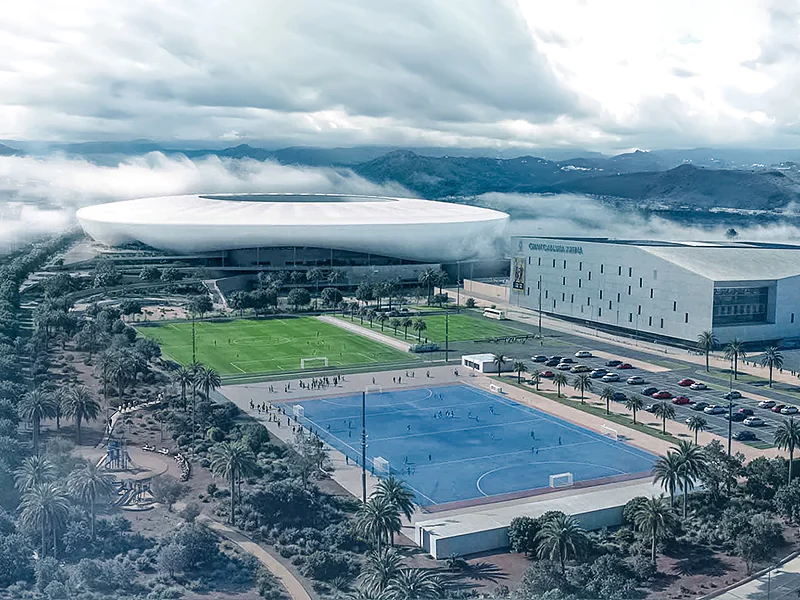
The Gran Canaria Island Council has postponed the start of expansion and renovation works at the Gran Canaria Stadium in Las Palmas, Canary Islands, Spain, until 2027 following the first tender, floated on June 7th, receiving no bids.
The Council is taking a second shot at the tender exercise so that a company can be picked who can start work on the most majestic arena redecoration project planned.
‘laprovincia.es’ stated that however, the Gran Canaria Island Council has maintained that it will stick to the 36-month (three-year) construction period to ensure that the Gran Canaria Stadium can host matches of the 2030 FIFA World Cup™.
New Tender
The newly floated tender for the venue project sets a maximum budget of €234,801,620, €60 million more than the previous one. This price increase is aimed at attracting the construction companies as the first tender, published on June 7th, received no bids. The cost of the roofing alone exceeds €93 million thus representing an increase of more than half the amount announced in the initial bidding process two months ago.
Bids’ Deadline
The deadline for submitting the bids is the noon of September 11th so the companies will have barely a month to review them especially considering the fact that it’s a busy holiday month. The opening of the financial bids would take place on October 14th.
The Gran Canaria Island Council is the specific Government and public administration body for the island of Gran Canaria in Spain.
Created in 1912, it manages the local affairs, the public services, the infrastructure, and the regional development across the island’s 21 Municipalities.
The 32,418-seat Gran Canaria Stadium is a football stadium in Las Palmas, Canary Islands, Spain. It is currently used for football matches and is home to the UD Las Palmas who compete in the Segunda División, the second tier of the Spanish football league system.
The 2030 FIFA World Cup™ is scheduled to be the 24th FIFA World Cup™, the quadrennial international football tournament that is contested by the Men’s national teams of the member associations of FIFA. The tournament is planned to be jointly hosted by Morocco, Portugal and Spain. In honor of the 100th anniversary of the first edition in 1930 a special match and celebration are scheduled to be held at the 60,235-capacity Centenario Stadium in Montevideo, Uruguay – host stadium of the 1930 Final – as well as one match each in the 85,018-capacity Monumental Stadium in Buenos Aires, Argentina, and the 32,000-capacity Osvaldo Dominguez Dibb Stadium in Asunción, Paraguay. It will be held from June 8th-July 21st, 2030.
‘La Nube’
‘laprovincia.es’ further stated that the name La Nube ‘The Cloud’ reflects the stadium’s holistic design which incorporates water and energy-harvesting technologies. It is the winning architectural design concept selected to comprehensively expand and remodel the Gran Canaria Stadium.
Stadium Capacity
The Gran Canaria Stadium currently has a capacity to hold 32,418 spectators which will be expanded to 44,022 seats when the renovation work is completed.
Fog-capturing System
One of the most unique elements in the revamped venue will be the fog-capturing system which has been conceived as “an active/passive infrastructure integrated into the roof of the new Gran Canaria Stadium capable of capturing, channeling, minimally treating, and reusing water from the ambient humidity (fog/mist), nighttime condensation (temperature dew) and humidity generated by occupancy during the events”.
Closed Water Cycle
The aim is to establish a closed water cycle for non-potable uses, primarily irrigation and supplementing the greywater network (cisterns, cleaning and auxiliary uses) thereby reducing dependence on the potable water.
Noise Factor
As regards the noise factor in the redecorated Gran Canaria Stadium the venue will comply with the noise ordinance with a limit of 55 decibels during the day and 45 at night.
A noise ordinance is a local law or Municipal rule that sets limits on the volume and type of allowable sound in the public and the private spaces during specific times. These rules prevent excessive disturbances, protect public health and maintain community peace.
Second Shot
The Gran Canaria Island Council is taking a second shot to hire a company to take charge of the most emblematic and expensive sports project. Once the revitalization work is over it will act as a catalyst to put the Gran Canaria Stadium on the world stage of sport with the greatest international mass mobilization, a sport (soccer) in which Spain is currently the leader.
Reluctant Companies
The new construction project is trying to get off the ground after the previous tender failed to attract any bids from the construction companies who considered the budget 40 percent below the market prices. The new tender aims to adjust the material prices following a significant price rise due to the highly volatile geopolitical situation in the world today.
Budget
The maximum budget has been set at 234,801,620 euros compared to 174,714,207 euros for the first tender.
Timeline
The construction period timeline has been set at 36 months. However, 2026 is not being taken into consideration as the expansion and revamp work of the Gran Canaria Stadium has been postponed until 2027 following the first tender process receiving no bids. The work will now be spread over three years although the completion date has been set for 2029 to allow for some leeway to address any unforeseen issues as well as to meet FIFA’s benchmarks for hosting major sporting acts.
Funds Allocated
The funds allocated for the three-year period are 37,965,603 euros in 2027, another 69,083,769 euros in 2028 and a final instalment of 127,752,248 euros in 2029.
Materials’ Cost
The total cost of materials amounts to €184,404,005 (excluding overhead and profit) of which over 50 percent will go towards the roofing cost thus representing an outlay of more than €93 million. This cost overrun is particularly significant considering that the initial tender two months ago estimated the cost at €60.5 million which means that the final bill has now more than doubled (already accounting for 44.1 percent of the total cost of materials). The cost of concrete and structures follows far behind at over 12 percent which, in real terms, amounts to almost €22.4 million.
Labor Cost
Meanwhile, the cost of labor is estimated at 46,719,317 euros which will require a large number of skilled workers belonging to the construction sector.
Price Revision
The tender establishes a possible price revision during its execution “given the multiyear duration of the contract (2027-2029) and the exposure to variation in the costs of the basic materials” as was also the case in the previous tender.
Multiple Award Criteria
The contracts will be awarded using the multiple award criteria based on the best value for money. The evaluation of the tender will be conducted using the criteria quantifiable through value judgments (25 percent) and evaluable through formulas (75 percent). Among these, the proposed price stands out accounting for 65 points. The project completion timeframe, in turn, awards 10 points.
Continue following Coliseum for the latest updates on sports venues, stadiums and arena business news worldwide.
Coliseum is dedicated to building a global community of sports and entertainment venue professionals helping create better and more profitable venues.
Become a member of the Global Sports Venue Alliance and connect with stadiums, arenas and industry experts from around the world. Apply for membership through the Global Sports Venue Alliance and access the 365Coliseum Business platform.