


Football banning orders have been issued to two men in England after they were convicted for breaking a new ‘tailgating’ law at last month’s Carabao Cup final at Wembley.
The BBC said the bans were issued following new legislation being introduced on unauthorised entry to football matches and which came into effect before Manchester City’s 2-0 win over Arsenal at Wembley.
Police arrested and charged three men under the new legislation, with the first two having been issued with three-year football banning orders.
The new act has been designed to clamp down on ‘tailgating’ – where supporters without tickets push their way through turnstiles by staying close behind legitimate ticket holders.
It is also illegal to knowingly attempt to gain entry using forged tickets, passes and accreditation documents, or by posing as a member of staff.
Until the new laws came in, there had been no specific legal penalties for entering a football match without a ticket, with supporters who were caught doing so tending to be ejected without any further punishment.
Sixty-nine arrests were made in relation to the Carabao Cup final at Wembley in 2025, with the Metropolitan Police confirming at the time that the majority had been for trying to get into Wembley without a ticket.
But until the new legislation was introduced, police could only charge a culprit with suspected fraud, making prosecution unlikely. Football banning orders can now be imposed.
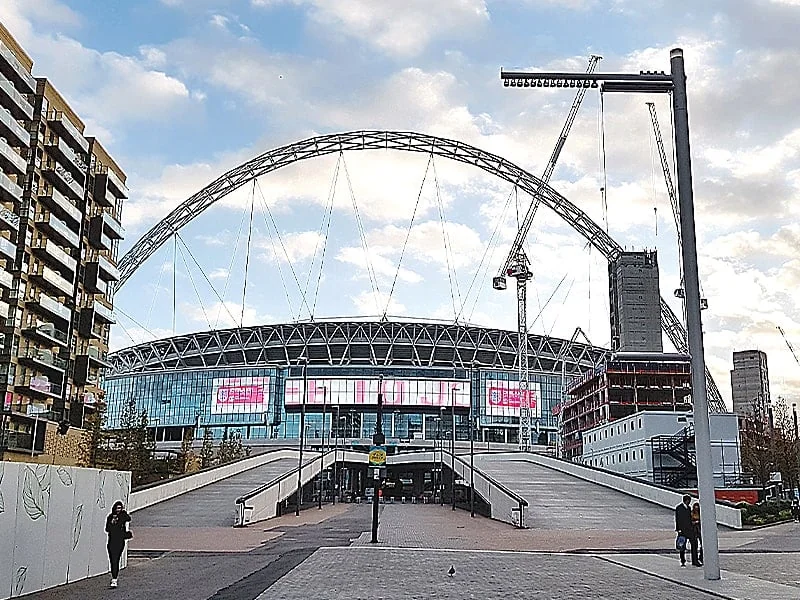
The 90,000-capacity Wembley Stadium, currently branded as the Wembley Stadium connected by EE for sponsorship reasons, is a football stadium in Wembley, London, England (UK). It opened in 2007 on the site of the original Wembley Stadium which had stood from 1923 until 2003.
Wembley Stadium director Mark Lynch said, “This new legislation is already having a real and immediate impact. Previously, there were no specific criminal penalties for those trying to enter the stadium without a ticket, placing significant pressure on our crowd safety teams.
“This new legislation now closes that gap and ensures offenders are dealt with appropriately.
“These cases send a clear message that any attempt to gain unauthorised access to football matches will not be tolerated and will result in firm action including large fines and lengthy football banning orders.”
Chief Inspector Pete Dearden, of the Metropolitan Police, said: “Our officers acted quickly and decisively at the Carabao Cup final, and these convictions demonstrate that antisocial, dangerous and criminal behaviour at football matches will be met with firm enforcement action.”
He added that police will continue to work with the Football Association and other partners to “prevent the minority who seek to cause harm or disruption from doing so”.
A Football Association (FA) commissioned report led by Baroness Louise Casey said the serious disorder at the European Championships final in 2021 final could have led to deaths.
It found that about 2,000 people got into the match illegally, with 17 mass breaches of disabled access gates and emergency fire doors.
The Unauthorised Entry to Football Matches Act follows Baroness Casey’s findings that sanctions on breaking into stadiums were weak, and that tailgating should become a criminal offence.
Continue following Coliseum for the latest updates on sports venues, stadiums and arena business news worldwide.
Coliseum is dedicated to building a global community of sports and entertainment venue professionals helping create better and more profitable venues.
Become a member of the Global Sports Venue Alliance and connect with stadiums, arenas and industry experts from around the world. Apply for membership through the Global Sports Venue Alliance and access the 365Coliseum Business platform.