


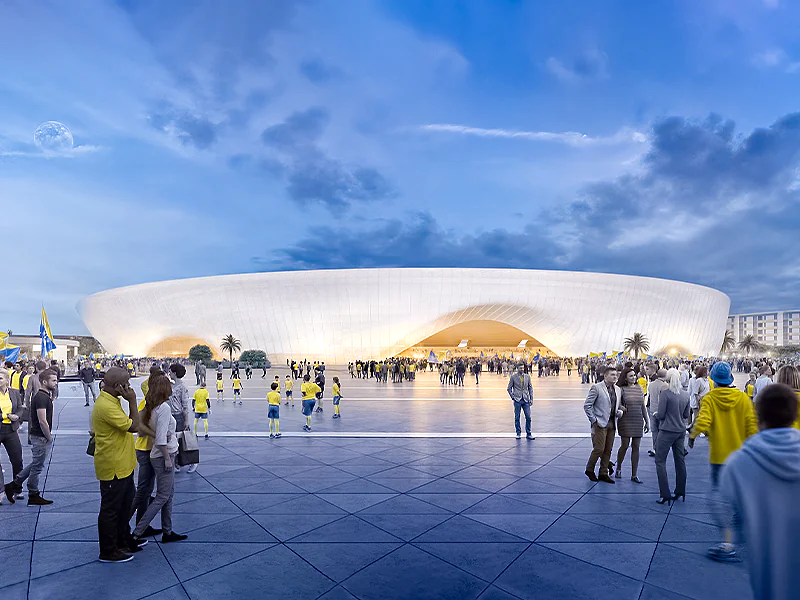
The architects behind the redevelopment of the Gran Canaria Stadium have given more details on the project during Gran Canaria Architecture Week.
A contract has recently been signed for work to demolish parts of the stadium including the eastern building and tower. Demolition is slated to get underway in November.
L35 Architects said the signing of the contract for the renovation and expansion of the Gran Canaria Stadium marks the beginning of the ambitious ‘La Nube’ project, which will transform the venue into an architectural and sustainable landmark, ready to host the 2030 FIFA World Cup.
Plans are to raise stadium capacity by more than 37 percent to 44,462 seats from 32,400 currently.
The Gran Canaria Stadium is a football stadium in Las Palmas, Canary Islands, Spain. It is currently used for football matches and is home to the UD Las Palmas, which competes in the Segunda División, the second division of the Spanish football league system.
Founded in 1967, L35 Architects is an international architecture, urbanism and design firm with offices in Barcelona, Madrid (Spain), Paris (France), Milano (Italy), Miami (US), Mexico, Bogotá (Colombia), Santiago (Chile), Istanbul (Türkiye), and Abu Dhabi (United Arab Emirates).
One of the most distinctive aspects of the ‘La Nube’ project is its holistic approach to sustainability.
This is particularly visible in the stadium’s envelope, which will integrate innovative materials that, while giving it an iconic identity, are also designed to maximize natural light and enhance ventilation, thereby significantly reducing energy consumption.
The Gran Canaria Stadium aims to be much more than a football venue. The ambition is to turn it into a social and cultural hub, capable of attracting international visitors while becoming a genuine meeting point for the people of Gran Canaria.
L35 Architects Senior Partner Alejandro Lorca said: “Our goal is to create a stadium that is not only iconic from an architectural standpoint, but also responds to the needs of the community and is aligned with the challenges of climate change. We want ‘La Nube’ to become a symbol of sustainability and modernity.”
The stadium’s distinctive white, translucent architecture will allow it to blend seamlessly into its surroundings while forming a unique, environmentally conscious urban microclimate with advanced acoustic absorption.
One of the most significant improvements will be accessibility. The design introduces large open spaces in the Northeast and the Southwest corners to facilitate smoother entry and exit seamlessly integrating with the surrounding urban landscape.
The North and South Stands will be repositioned, enhancing proximity to the pitch for fans without altering the existing levels.
The North Stand will be designed to accommodate alternative events such as concerts through the use of retractable seating. Additionally, the hospitality areas, the VIP lounges and the food and beverage (F&B) services will be significantly upgraded.
A standout feature of ‘La Nube’ is its cutting-edge, sustainable construction. The exterior enclosure will consist of an intelligent, translucent membrane made from ethylene tetrafluoroethylene (ETFE), a lightweight, highly durable thermoplastic polymer combined with recycled laminated glass.
This will not only enhance the aesthetics but also enable the inclusion of commercial spaces within the stadium’s perimeter.
The ETFE will also be used for the stadium’s roof reducing the structural costs while ensuring high energy efficiency. The project will integrate state-of-the-art sustainability measures including textile photovoltaic (PV) panels, mini wind turbines, geothermal energy, photocatalytic paving to improve the air quality, and the biomimetic systems to capture atmospheric moisture.
Project Lead Guillermo Gusó added, “This is a unique opportunity for Gran Canaria —an inspiring project that should bring everyone together under the common goal of hosting the 2030 FIFA World Cup.”
With a design that combines innovation, functionality, and environmental responsibility, L35 Architects builds on its renowned trajectory in sports architecture, adding the Gran Canaria Stadium to iconic projects such as the Santiago Bernabéu Stadium, the Simón Bolívar Stadium, and the Nemesio Camacho Stadium (El Campín).
Continue to follow Coliseum for latest updates on venues business news. Coliseum is dedicated towards building the best global community of sports and entertainment venue executives and professionals creating better and more profitable venues.
Become a member of the only Global Sports Venue Alliance and connect with stadiums, arenas and experts from around the world. Apply for membership at coliseum-online.com/alliance and make use of the 365Coliseum Business.