


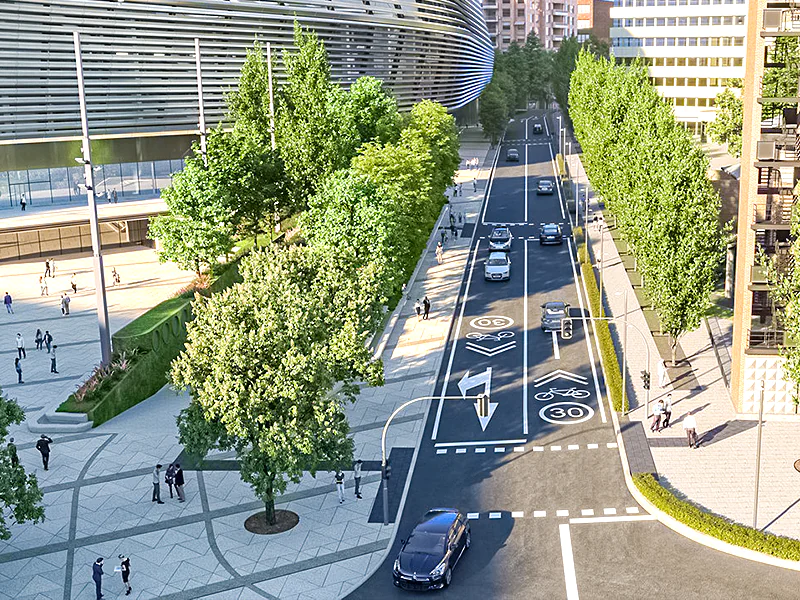
Madrid City Council has given the green light to the modified urban development project plan for the Santiago Bernabéu Stadium area.
Diario de Madrid said the works will be carried out and financed by Real Madrid and supervised by the Department of Works and Facilities.
The modification will adapt the project approved in 2018 to the stadium’s remodeling and the comprehensive renovation of the Santiago Bernabéu Metro Station. The investment in the projects exceeds €19.6 million, which will be fully funded by the club.
Real Madrid CF, commonly referred to as Real Madrid, is a Spanish professional football club based in Madrid, Spain. The club competes in LaLiga, the top tier of Spanish football.
The Bernabéu Stadium is a retractable roof football stadium in Madrid, Spain. With a seating capacity of 78,297 the stadium has the second-largest seating capacity for a football stadium in Spain. It has been the home stadium of Real Madrid since its completion in 1947.


As part of the changes to the original plans, the pedestrian area will increase from 14,500 m2 to 40,500 m2, 4,500 m2 of landscaped areas will be created, and more than 300 new trees will be planted, improving the environmental quality of the area.
The projects are divided into four main areas: Rafael Salgado Street (already completed), Concha Espina Avenue, Castellana Avenue, and Padre Damián Street.
The urbanization works will completely renew all pavements, the public lighting system, the irrigation system, and the sewer system. A sustainable urban drainage system will also be incorporated to optimize rainwater management.
The installation of more than 1,000 meters of granite benches and a dozen new wooden benches is planned.
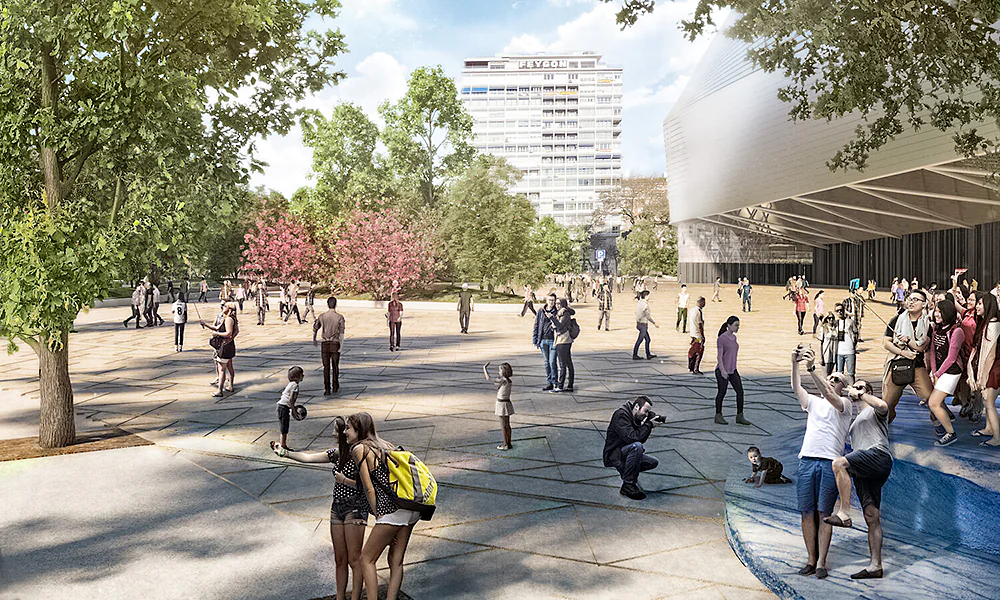

Traffic management will also be improved with better traffic lights in the surrounding area and the creation of two new pedestrian crossings at Concha Espina and Padre Damián.
Some 36 parking spaces for residents will also be provided, including spaces reserved for people with reduced mobility, 19 spaces for non-residents, 16 for motorcycles, and six for taxi reservations.
The project builds on the work already carried out by Real Madrid on the area between Concha Espina Avenue and Padre Damián Street, where the La Esquina del Bernabéu Shopping Center was previously located, which was demolished, gaining 5,500 m2 of surface area for public use.
The work on Rafael Salgado Street is now complete, as it forms part of an untouched part of the project. Pedestrian space in this area has been substantially expanded. In the case of Concha Espina Avenue, where work has already begun on the untouched portion, the sidewalks will be widened, both those in contact with the residential buildings and those of the stadium, leaving the roadway with two lanes of traffic in each direction.
On the Castellana street front, a large, fully pedestrian plaza covering nearly 20,000 m2 will be created.
The 1982 World Cup gardens will be restored, and the one-way bike lane that runs from Raimundo Fernández Villaverde Street to Plaza de Castilla, passing through Plaza de Lima, where the sidewalks will also be significantly widened, will be continued.
Meanwhile, on Padre Damián Street, as on Concha Espina, both sidewalks will be widened, reaching, in this case, twice their current dimensions.
The Sagrados Corazones roundabout will be reconfigured, taking the shape of a perfect circle through the widening of sidewalks and the restoration of the landscape of its split roundabout.
Continue to follow Coliseum for latest updates on venues business news. Coliseum is dedicated towards building the best global community of sports and entertainment venue executives and professionals creating better and more profitable venues.
Become a member of the only Global Sports Venue Alliance and connect with stadiums, arenas and experts from around the world. Apply for membership at coliseum-online.com/alliance and make use of the 365Coliseum Business.