


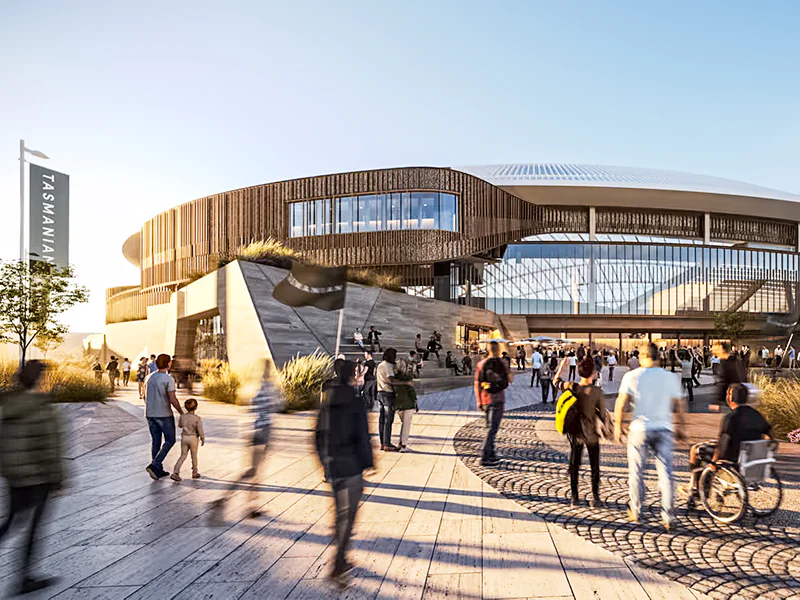
The planned new Macquarie Point Stadium for the first AFL team in Tasmania, Australia has been slammed by the state’s planning commission.
In its final report, the Tasmanian Planning Commission (TPC) described the proposed venue as a “monolithic blot” on Hobart’s landscape and cultural heritage.
The Guardian said the damning report comes as the state’s premier, Jeremy Rockliff, admitted that the cost of the development had jumped by almost 20% to A$1.13bn.
The TPC concluded that the benefits of the stadium at Macquarie Point in Hobart were outweighed by its social, environmental and financial costs.
The Macquarie Point Multipurpose Stadium is a significant infrastructure development project that is planned as a key part of the urban renewal of Mac Point.
The 23,000-capacity, roofed venue is scheduled to begin construction in 2026 and open in 2029 as the home ground of Tasmania Football Club.
Tasmania Football Club, nicknamed the ‘Devils’, is a professional Australian Rules football club set to compete in the AFL from the 2028 season and the AFL Women’s league from an unspecified date. The club will be based in Tasmania with matches to be played across the State.
When it starts play in 2028, Tasmania Football Club will play its home games at the existing 20,000-capacity Bellerive Oval in Hobart and at the 21,000-capacity York Park in Launceston, Tasmania, while the Macquarie Point Stadium is built.
COX Architecture was last year named as the Lead Design Consultant for the Macquarie Point stadium.
The AFL views the Hobart stadium as a non-negotiable condition for Tasmania’s entry into the competition from 2028, but the development has been criticised on multiple fronts.
The Tasmanian Symphony Orchestra (TSO), located just 170 metres from the site, commissioned two independent acoustic studies.
Both warned that without significant mitigation, sound spill and vibration from the stadium could disrupt performances, recordings and filming activities well beyond the stadium’s 2029 opening.
The Tasmanian RSL has focused on the impact the stadium’s 54-metre-high dome would have on sightlines of the Hobart cenotaph, Australia’s oldest war memorial.
The TPC sided with the RSL, concluding that the adverse effects on the cenotaph, as well as heritage-listed buildings in Hunter Street, the Royal Engineers Building and the general character of Sullivans Cove, were unacceptable.
The report warned of “irrevocable and unacceptable adverse impacts” on the surrounding communities and businesses and questioned the stadium’s ability to activate the precinct outside major events.
“The panel does not consider that the stadium building will be iconic, as claimed by the [AFL],” the report concluded.
Rockliff said, “Stadiums are complex, and this is the reason why across the nation special laws are used to approve them, instead of the traditional planning scheme,” he said in a statement.
“It is now time for MPs to have their say. As a growing state, reaching for aspiration and opportunity for young people, we must pursue ambitious projects like that at Macquarie Point.
“It will create jobs, boost our tourism and hospitality sector, secure world-class entertainment and keep our economy strong. It is time to get on with the job.”
Continue to follow Coliseum for latest updates on venues business news. Coliseum is dedicated towards building the best global community of sports and entertainment venue executives and professionals creating better and more profitable venues.
Become a member of the only Global Sports Venue Alliance and connect with stadiums, arenas and experts from around the world. Apply for membership at coliseum-online.com/alliance and make use of the 365Coliseum Business.