


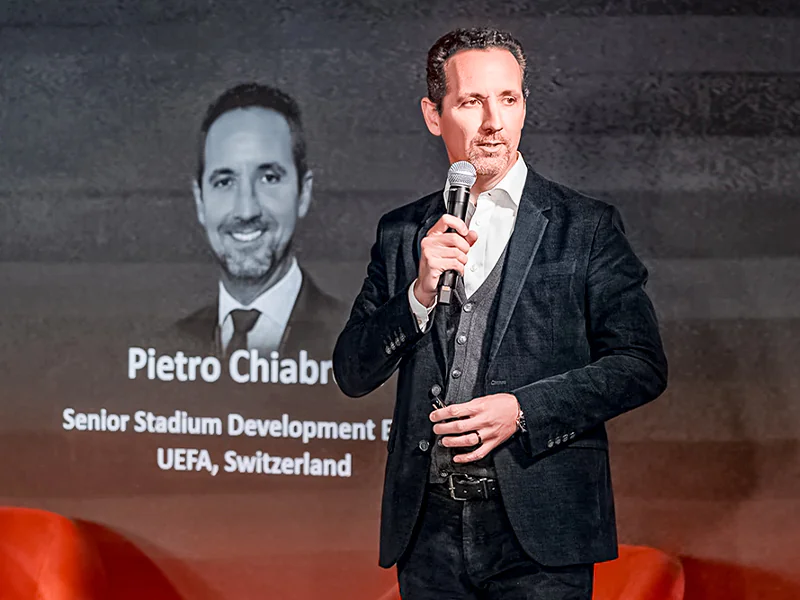
Pietro Chiabrera who is with the Union of European Football Associations (UEFA) talks about the UEFA regulations.
Pietro Chiabrera is a seasoned sports management professional with over 20 years of international experience in orchestrating and delivering high-profile events. During his extensive tenure at the UEFA he has cultivated deep expertise in football operations and stadium development, advising the national associations and the clubs on best practices for stadium construction and management.
In an engaging conversation with ‘Coliseum’, Pietro Chiabrera, Senior Stadium Development Expert, UEFA, Switzerland, says that the UEFA regulatory framework works in an upside-down pyramid – “It means that the stadium regulations sit at the very bottom of the pyramid. And it means that they are not representing the whole panorama of documents that the stadium operators, or architects, or the designers, or the developers need to be aware of before starting to put pencil on the paper.” He also talks about the stadium consultancy services which the UEFA provides free of charge for the stadium developers, the designers, the architects, the clubs, the federations, and the Government and Chiabrera stated that the stadiums and the clubs “are not currently getting in touch with us and he encouraged the clubs to “join us and share documentation and we will like to look at those, provide you our inputs in order to avoid changes at a later stage”.
UEFA
Nyon (Switzerland)-based the Union of European Football Associations (UEFA) is the governing body of football in Europe and one of FIFA’s six continental confederations for association football consisting of 55 national associations.
Stadium Regulations
Pietro Chiabrera started by stating, “In order to make the stadium regulations we need to be up-to-date, we need to know what are the trends, what are the new things that are coming up and we need to adapt and ensure that we manage the documents that we are putting together in the right way. We need to start with the stadium regulations which are the very minimum but then add on the competition requirements because, for example, in each competition requirements we have the quantity of seats, of the benches.”
Operational Requirements
“And then there are the operational requirements They are called the club manuals and they are very much thicker than the stadium regulations and the competition regulations. They go into very fine details, for example, giving you the quantity of power plugs that you need to have in an indoor studio. They give you the diagrams and the drawings of how a commentary position needs to be in a venue with three seats, power plugs and so on.”
UEFA-compliant
“So, to be UEFA-compliant you just do not have to comply with the minimum criteria but the stadia need to put the big picture together with all the documents together. We focus mainly on these areas – the spectators, the players and then the terminology, and the glossary. We actually look at the pitch quality and the pitch surroundings but we also focus a lot on the spectators. We have developed a few documents that are the guiding principles and we have taken from those guiding principles key criteria.”
Sanitary Facilities
“The sanitary facilities in the stadiums, about the ratio between male and female. The UEFA is asking to overprovide toilets for the females in the stadiums which means that we are asking to do more. It’s actually to ensure that the level of service is increased because we have been seeing too many times in too many stadiums long queues of people that wanted to use the toilet and eventually missing the goal of Cristiano Ronaldo, or Lionel Messi or you name it – the heroes that are playing on our football pitches.”
Disability
“Disability is also a very important topic. The UEFA has improved significantly the provision for the wheelchair users. We started with the wheelchair users’ disability but there are also non-visible disabilities that exist. But what is the most important one when it comes to the infrastructure is the wheelchair because a visually impaired can eventually move and be accompanied to a seat while a wheelchair disabled spectator cannot really easily maneuver and access the stadium.”
Demountable Tribunes
“The Demountable Tribunes is a topic that we are going to go and work on. Currently, it is not touched. We will touch it in the future. At the moment these types of scaffold structures are not allowed but we are going to work on it and very soon we will launch a Working Group to define how to use those tribunes in the modern football stadiums.”
Pitch Surroundings
“The UEFA wants to put emphasis on the pitch surrounding. When it comes to the players’ safety we really want to put the emphasis on this and that’s what we have done – clarify the diagram of the pitch surroundings and the pitch surroundings requirements are being verified.”
Football Sustainability Strategy 2030
“The social and environmental issues are increasingly challenging our society. European football must come together to aspire, activate and accelerate sustainable action as one team using a common language and a long-term vision. The UEFA has developed a Football Sustainability Strategy 2030 will 11 policies addressing the human rights and the environment. These are implemented in five areas and accelerated – the clear targets and the measurable Key Performance Indicators (KPIs). This approach acts as an example for the Member Associations, the leagues and the clubs to develop their own strategies.”
Wrap-up
Standing Facilities
Pietro Chiabrera concluded by stating, “The standing facilities is actually a very sensitive topic and we are coming to the end of a long journey. This was a program that was launched five years ago. We call it the Observer Program. It’s actually used and was used to allow the UEFA to learn how the clubs and the federations and the countries are currently using in the standing facilities as you might know there has been a momentum in the last few years and we have been also pressured by the clubs and the federations to reintroduce standing facilities in some sectors in the stadiums especially in the hardcore fans’ sectors. We are definitely going in the direction of allowing standing in the football stadiums in European competitions with the regulatory framework finding the minimum criteria which needs to go hand in hand with the regulations from the national legislator. So, the countries that do not allow the standing facilities will not all of a sudden allow because the UEFA allows it. It depends on the national legislation but we are going to define the criteria that would need to be used and follow.”
Continue following Coliseum for the latest updates on sports venues, stadiums and arena business news worldwide.
Coliseum is dedicated to building a global community of sports and entertainment venue professionals helping create better and more profitable venues.
Become a member of the Global Sports Venue Alliance and connect with stadiums, arenas and industry experts from around the world. Apply for membership through the Global Sports Venue Alliance and access the 365Coliseum Business platform.