


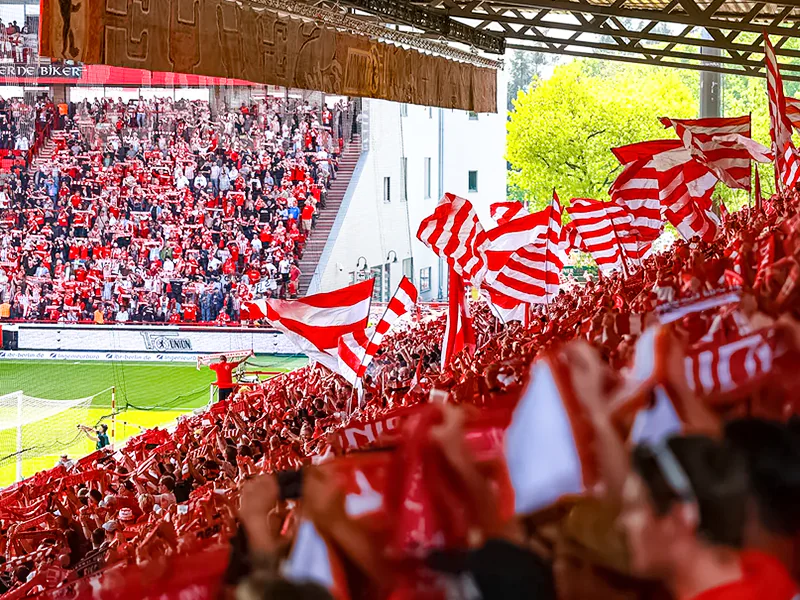
Bundesliga football club 1. FC Union Berlin is delaying its temporary move to Berlin Olympic Stadium from its Stadion An der Alten Försterei home when renovation works take place.
Union Berlin said President Dirk Zingler informed club members in a letter that the club has agreed with the Olympic Stadium to use it during the 2027/28 season, rather than a year earlier, and that relevant contracts are being drawn up.
Zingler said, “We are adjusting our construction schedule and now expect to play our last home game at the Alte Försterei in May 2027 and return to Köpenick for the first home game of the 2028/2029 season.”
1. FC Union Berlin is a professional football club based in Berlin, Germany, that plays in the Bundesliga, the highest level of the German football league system.
The Stadion An der Alten Försterei is a football stadium in Köpenick and the largest single-purpose football stadium in the German capital of Berlin. It serves as the home pitch of football club 1. FC Union Berlin.
The club had originally planned to up capacity to 40,500 through the renovation but local authorities concluded that the transport infrastructure around the Alte Försterei—especially in the Köpenick area—cannot support the higher number of fans that a 40,500-capacity stadium would bring.
The original plan relied heavily on shuttle-bus schemes to manage match-day crowd flows. But the city (the Berlin Senate) rejected that as insufficient.
As a result, the expansion plan has been scaled back: the new stadium will open with a capacity of 34,500 (rather than 40,500) — 22,500 standing and 12,000 seated.
The reduced capacity and the need to revise the stadium layout has triggered a delay in the construction schedule.
Zingler said in the letter, “At the end of September, we first informed you, our members, and then the public that we had decided to build the Stadion An der Alten Försterei as presented in 2024, but to initially open it with a capacity of 34,500 seats.
“The aim was and is to speed up the approval process required for planning law. Based on our decision, the Senate Departments for Urban Development, Construction and Housing and for Mobility, Transport, Climate Protection and the Environment have declared that a ‘viable compromise for the transport concept’ has been found.
“In a joint statement, we also announced that the commissioning with reduced capacity is only an interim step and that the goal of all parties involved is to subsequently extend the approval to the originally planned 40,500 capacity as soon as possible.”
Zingler said that in recent weeks, alongside the stadium working group of the fan and member department and other relevant groups within our club, discussions have surrounded possible options for the distribution of seats and standing room and the specific layout of the Waldseite.
He added, “As a result, we have agreed to have the entire Waldseite and the lower tier of the expanded stadium as standing room only.
“During the reduced capacity approval phase, this standing room will hold a correspondingly reduced occupancy rate. The losses incurred will be mitigated by a slight price increase for all stadium visitors, which will not completely offset the loss of revenue, but will reduce it.
“The capacity of 34,500 seats will initially be divided into 22,500 standing places and 12,000 seats. In this way, we are preserving standing room terrace culture as a fundamental part of our stadium experience while also accommodating the wishes of many, especially older Union fans, for seats.”
Continue to follow Coliseum for latest updates on venues business news. Coliseum is dedicated towards building the best global community of sports and entertainment venue executives and professionals creating better and more profitable venues.
Become a member of the only Global Sports Venue Alliance and connect with stadiums, arenas and experts from around the world. Apply for membership at coliseum-online.com/alliance and make use of the 365Coliseum Business.