


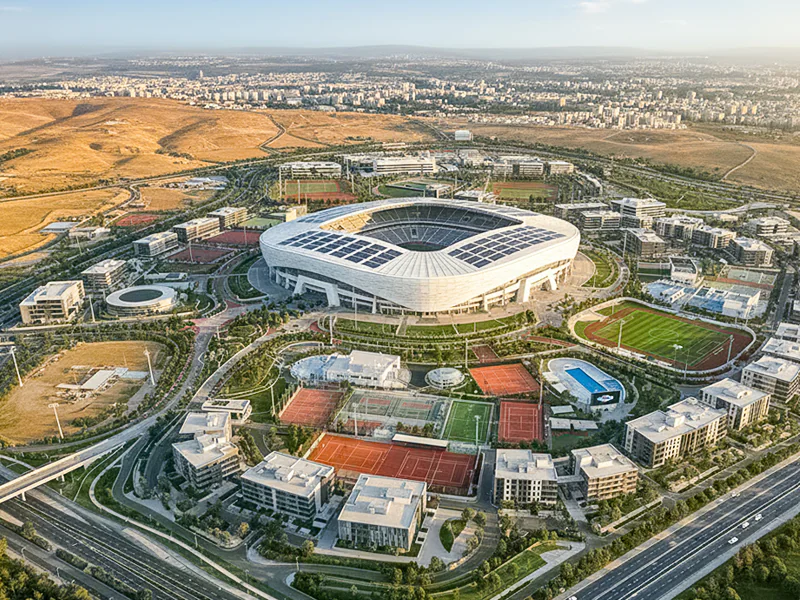
The country of Jordan has begun preliminary excavation and site preparation works for the 46,000 capacity Al Hussein Bin Abdullah II International Stadium.
Invest Jordan said the venue is a landmark sports infrastructure project that will become Jordan’s largest stadium upon completion.
The Jordan stadium project forms a key component of the first phase of the Amra City development and is scheduled to be completed and officially opened by the end of 2029.
The stadium will have a seating capacity of 46,000 spectators, making it the largest stadium in the region.
Once completed, the Al Hussein Bin Abdullah II International Stadium is expected to play a significant role in enhancing Jordan’s sporting infrastructure and increasing the country’s capacity to host major regional and international sporting competitions.
The new stadium is being designed in accordance with the latest international standards and sustainability requirements.
The Jordan stadium project will incorporate advanced construction technologies alongside integrated infrastructure to support large-scale sporting events.
Plans for the stadium include parking facilities with capacity for up to 6,000 vehicles, dedicated training pitches, supporting facilities, and a range of advanced services for athletes, teams, and spectators.
The Jordan Company for the Development of Cities and Facilities, a wholly state-owned company operating under the Jordan Investment Fund, is responsible for overseeing the project’s implementation, promoting investment opportunities, engaging developers and attracting local and foreign investment to the wider Amra City project.
The initial works pave the way for the official launch of construction at the beginning of 2027, according to the Jordan Company for the Development of Cities and Facilities.
Construction is expected to be completed in time for the venue’s planned opening in late 2029.
The project includes a range of supporting facilities, including two training pitches. The stadium will also be connected to public transport networks and Bus Rapid Transit (BRT) routes.
The company said the stadium’s design draws on elements of Jordan’s cultural and architectural heritage, reinterpreted through a modern approach that meets international sustainability standards.
The venue is being developed to world-class specifications, with a focus on energy and water efficiency and the integration of advanced smart technologies used in leading international stadiums.
The surrounding area will feature landscaped green spaces planted with trees and vegetation native to Jordan. Current works include site organisation, land grading and foundation excavations.
The Jordan stadium project is expected to provide a significant boost to the economy by supporting the construction, contracting and manufacturing sectors, while creating hundreds of jobs during both the construction and operational phases.
Upon completion, the stadium is expected to strengthen Jordan’s sports infrastructure, support the development of local athletics and enhance the Kingdom’s ability to host major regional and international sporting events.
Prime Minister Jafar Hassan launched the Amra City Project in November last year.
The government said at the time that the long-term urban development initiative is aimed at managing population growth, creating investment opportunities, and providing sustainable living solutions for future generations.
Planned over 25 years, the project is intended as a model city rather than a new administrative capital, the government said in a statement, adding that the mega project’s launch follows directives from His Majesty King Abdullah in the Letter of Designation.
The first phase of the project includes major projects such as an international exhibitions and conferences centre to be completed in 2027, an integrated sports city featuring an international football stadium to be completed in 2029, an Olympic city, Olympic-standard indoor arenas, a car-racing track, an environmental park, and an entertainment city expected to open in 2028.
It will also include commercial and service zones, an educational city, a technology hub focused on investment in the education sector and expanded cultural facilities including an extension of the Royal Automobile Museum.
Continue following Coliseum for the latest updates on sports venues, stadiums and arena business news worldwide.
Coliseum is dedicated to building a global community of sports and entertainment venue professionals helping create better and more profitable venues.
Become a member of the Global Sports Venue Alliance and connect with stadiums, arenas and industry experts from around the world. Apply for membership through the Global Sports Venue Alliance and access the 365Coliseum Business platform.