


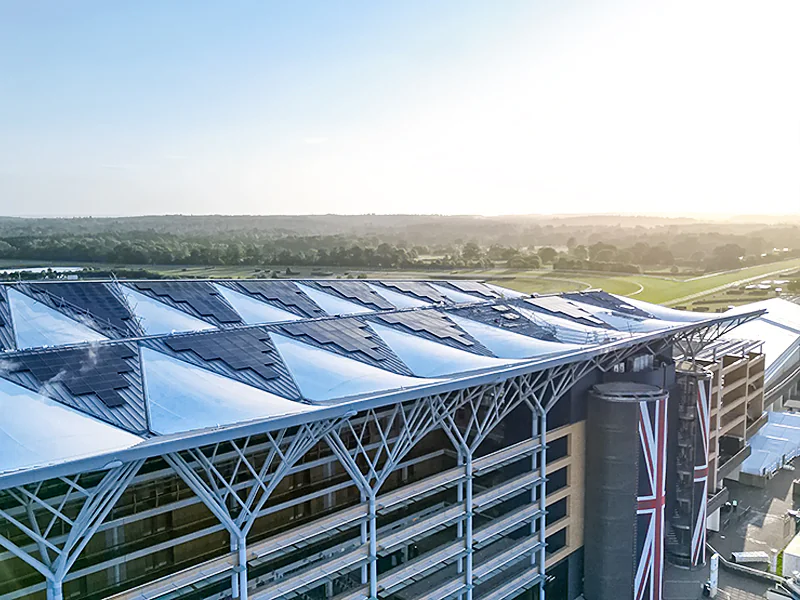
Ascot Racecourse has completed one of UK sport’s largest solar installations as it looks to boost its sustainability ambitions.
Ascot Racecourse said the rooftop solar system will help with its efforts to be one of the most sustainable sporting venues in the world.
As well as Royal Ascot and other racedays, it will support day-to-day operations and more than 180 non-racing events held at the venue each year.
Ascot Racecourse’s solar installation was completed ahead of Royal Ascot, running the length of the Grandstand to make it one of the largest of its kind at a sporting venue.
The major new rooftop solar array was delivered with SSE Energy Solutions and Ortus Energy.
The Ascot Racecourse solar installation will offset around 9% of Ascot’s annual electricity consumption and deliver year‑one carbon savings of approximately 118 tonnes of CO₂e, providing measurable emissions reductions.
It is expected to generate approximately 569,000 kWh of renewable electricity in its first year once energised, enough power for a medium sized electric car to drive just over one million laps of the course.
The Ascot Racecourse solar installation is designed so that 100% of the energy generated will be used on site, supporting day-to-day operations at Ascot Racecourse.
A horse running at 40mph would need to run non-stop for 14.5 years to produce the same amount of energy, while a field of eight horses competing over the Gold Cup trip of two-and-a-half miles would need to run for a combined time of 1.82 years.
Ascot now sits alongside the London Stadium and Manchester City’s campus as having one of the most substantial on-site solar installations in UK sport and is a flagship within British horse racing.
Felicity Barnard, Chief Executive of Ascot Racecourse, said, “This installation is a significant milestone for Ascot. It allows us to take a major step forward in our plans to cut emissions and strengthen the resilience of our operations.
“By turning our Grandstand roof into a long-term energy asset, and bringing the system online later this year, we will be supporting both our environmental commitments and the future sustainability of the racecourse.”
Tamsin Lishman, Customer Asset Director, SSE Energy Solutions, said, “Rooftop solar is one of the most effective ways for organisations to cut emissions while improving cost stability and energy security.
“Projects like Ascot demonstrate how commercial solar can be delivered at scale, even in complex and high-profile environ ments, helping customers build resilience and make tangible progress on their net zero ambitions once systems are energised.”
Alistair Booth, Chief Executive Officer, Ortus Energy, said, “Commercial rooftop solar is a major opportunity for the UK to cut emissions, particularly as the Government targets a significant expansion of solar capacity to 45 –47GW by 2030.
“In sport, organisations are also under growing pressure to reduce their environmental impact, with UK Sport identifying sustainability as a core pillar of its social impact strategy.
“Ascot Racecourse shows what’s possible when ambition, expertise and delivery align – acting ahead of mandate and setting the benchmark. Through a power purchase agreement, the system provides a robust, long-term solution with clear visibility on energy, us age and carbon savings once live – ensuring measurable, lasting impact.”
Continue following Coliseum for the latest updates on sports venues, stadiums and arena business news worldwide.
Coliseum is dedicated to building a global community of sports and entertainment venue professionals helping create better and more profitable venues.
Become a member of the Global Sports Venue Alliance and connect with stadiums, arenas and industry experts from around the world. Apply for membership through the Global Sports Venue Alliance and access the 365Coliseum Business platform.