


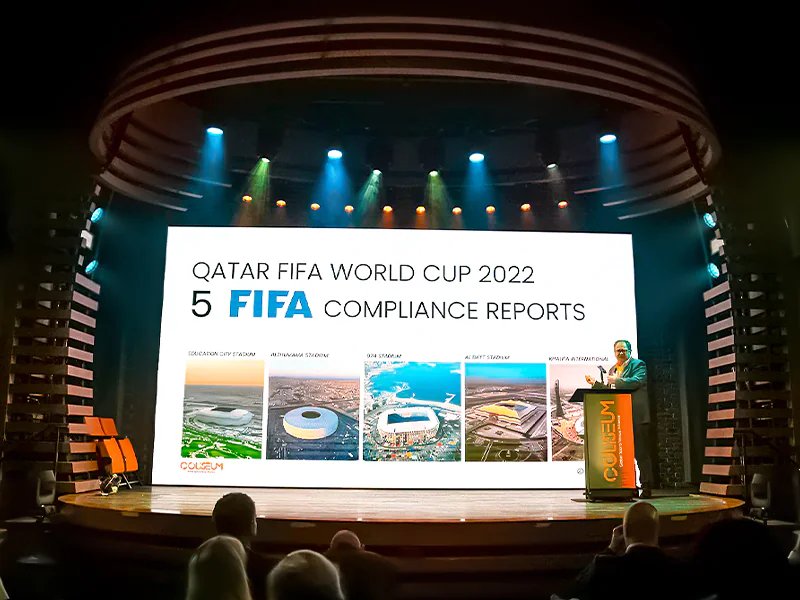
John Jackson who holds a top-slot position in Fenwick Iribarren Architects (FIA) stated that FIA was found 35 years ago and “in the last 25 years we have been expanding into sports architecture globally”.
Fenwick Iribarren Architects (FIA) achieved a hat trick by designing three of the stadiums used for the 2022 FIFA World Cup™ in Qatar. These projects were celebrated for their innovative, sustainable and culturally relevant designs.
John Jackson is the International Business Development Director of Fenwick Iribarren Architects. His role over the last 15 years has been very much focused on exploiting the company’s expertise in Sports Architecture.
In a chat with Coliseum, John Jackson, International Business Development Director, Fenwick Iribarren Architects, Spain, says that for Fenwick Iribarren Architects “the design is not just about sustainability or renovation but it is also about cultural identity and this is something we do in all our projects. We are always looking at the cultural identity, the image, or the local distinctive features where the venue is being built as part of our design concepts.”
Fenwick Iribarren Architects
Madrid (Spain)-based Fenwick Iribarren Architects is an internationally renowned architecture studio. With extensive experience across a wide range of architectural typologies the firm has developed projects on every continent.
Qatar 2022
The 2022 FIFA World Cup™ was the 22nd FIFA World Cup™, the quadrennial world championship for national football teams organized by FIFA. It took place in Qatar from November 20th-December 18th, 2022 after the country was awarded the hosting rights in 2010. It was the first World Cup to be held in the Middle East and the Arabian Peninsula and the second in an Asian country after the 2002 tournament in South Korea and Japan.
Informed John Jackson, “Going back to Fenwick Iribarren Architects we are stadium designers. We have designed 56 stadiums 12 of which have been built based in 20 countries, four continents and five national stadiums. Not only do we design stadiums we also do sports facilities, the arenas, tennis courts.”
Education City Stadium
The 44,667-capacity Education City Stadium is a football stadium which is located in Al Rayyan, Qatar, and was built as a venue in time for the 2022 FIFA World Cup™ held in Qatar.
Narrated Jackson, “The challenge we faced with the Education City Stadium was that it was the first cooling system in an open-air stadium. FIFA wanted to make sure that the stadiums would be open and they wouldn’t be enclosed air-conditioned. The challenge of having temperatures of 48 degrees and even close to 50 degrees and then coming down to 26 degrees within the stadium and they wanted to have an open-air sports facility. The difficult bit was keeping that cold air during the months, during the events. With the help of the engineers we created a double layered roof and vents and allowed the warm air to come in and mix with the cold air and created a screen between the cold bowl which was up to 26 degrees and the hot air which was blowing over and then we managed to design and make it work and so that we were left with a situation where you could have 48 degrees temperature outside and 26 degrees within the bowl.”
Al Thumama Stadium Cultural Identity
The 44,400-capacity Al-Thumama Stadium is a football stadium in Al Thumama district in Doha, Qatar, located approximately 13 km South of the City Center. It hosted the 2022 FIFA World Cup™ held in the country.
“We designed the Al Thumama Stadium as a symbol of the Qataris, their culture, etc. So, you can see it is the Gahfiya design – the cap that they wear – and the particular design is coming from specific Qatari designs and we used that as our main basis of design. They are very bold designs which is going to be permanently there for the legacy and it is going to be a club destination.”
Stadium 974
The 44,089-capacity Stadium 974 is a football stadium in Ras Abu Aboud, Doha, Qatar, about 10 km East of Doha. Officially opened on November 30th, 2021, Stadium 974 was the first planned temporary venue in the FIFA World Cup™ history.
It is the first dismountable and transportable stadium that can be rebuilt.
“They told us they did not want anymore white elephants. Qatar is a small country and what are they going to do with their World Cup stadiums. They wanted to completely transform or relocate the stadium. So, what did we do. We looked at the stadium as a traveling circus. We went back to basics. We took the simplest form of designing. How do you move these things around? In containers. The containers themselves became a part of the actual stadium design. The containers which are going to move from one place to another in a ship and they have to become the strong architectural feature of the stadium. We are not trying to hide them, we are not trying to conceal them. We are making them a feature of the design with the structure. The containers were designed in modules and it was prefabricated in China and brought to Qatar. Because the stadium is located in prime real estate land the idea was that they are going to build it for the World Cup and move it elsewhere. Everything has been designed in such a manner that it can be built and it can be dismantled.”
Wrap-up
John Jackson wrapped up by stating, “Right now we are working on the Serbian National Stadium which is currently under construction in Surčin near Belgrade. We are creating the first completely green façade and that façade is going to change with the seasons. We are opening up the stadium to the outside and it can work as a destination in itself.”
Continue to follow Coliseum for latest updates on venues business news. Coliseum is dedicated towards building the best global community of sports and entertainment venue executives and professionals creating better and more profitable venues.
Become a member of the only Global Sports Venue Alliance and connect with stadiums, arenas and experts from around the world. Apply for membership at coliseum-online.com/alliance and make use of the 365Coliseum Business.