


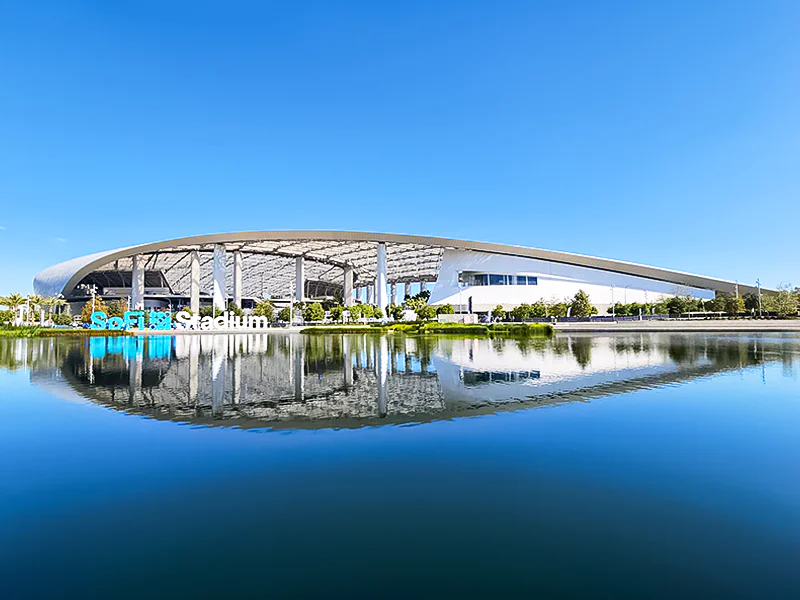
After FIFA awarded the hosting rights for the 2022 World Cup to Qatar that nation’s Government built seven stadiums and overhauled one existing venue for the competition. Naturally, there were no naming-rights deals or branded signage when FIFA arrived to dress the venues with its tournament branding and the logos of its corporate partners.
‘SPORTS BUSINESS JOURNAL’ stated that the situation heading into the 2026 World Cup in the United States, Mexico and Canada is completely different. Fifteen of the 16 stadiums, none of which was built specifically for the World Cup, have long-term naming-rights agreements and all of them are adorned with sponsor logos. If FIFA has its way, none of that will be visible this Summer.
The 2026 FIFA World Cup™, marketed as FIFA World Cup 26™, will be the 23rd FIFA World Cup™, the quadrennial international Men’s soccer championship contested by the national teams of the member associations of FIFA. The tournament will take place from June 11th-July 19th, 2026. It will be jointly hosted by 16 Cities – 11 in the United States, three in Mexico and two in Canada. The tournament will be the first to be hosted by three nations.
‘SPORTS BUSINESS JOURNAL’ further stated that the governing body’s policy ensuring that all World Cup venues are free and clear of existing commercial branding during the tournament is longstanding but the process of “cleaning” stadiums of marks and logos is a uniquely complex – and potentially costly – undertaking in North America.
The motivation behind FIFA’s insistence on commercially clean venues is protecting the exclusivity for which its sponsors are paying handsomely. The governing body expects to generate $1.8 billion in revenue from the sale of marketing rights in 2026, almost all of which is associated with the Men’s World Cup. Industry sources have put the value of top-level FIFA Partner deals between $150 million and $200 million per four-year cycle with tournament-specific designations costing as much as $100 million.
Unlike the International Olympic Committee (IOC), which for the first time is allowing for the sale of naming rights for Olympic venues in Los Angeles, FIFA is sticking with its policy of requiring that all World Cup venues be devoid of corporate names. The 82,500-capacity MetLife Stadium, for example, which will host the final on July 19th, will be known throughout the competition as the New York New Jersey Stadium.
Many naming-rights deals, particularly those signed in recent years, have carve-outs for major events like the World Cup to ensure the stadium operators don’t have to compensate those partners when an entity like FIFA takes over its venue. In some cases, however, events like the World Cup weren’t considered when the deal was signed.
Referring to the venues by FIFA’s unbranded names is just the beginning. The stadium owners have promised to turn their venues over to FIFA “free and clear of any and all advertising, marketing, promotion, merchandising, and brand identification”. This includes branding on “any stands, scoreboards, seats, seatbacks, time clocks, staff uniforms, accreditation passes, fences or elsewhere inside, surrounding or in the airspace above and around the stadium.”
Logos for the teams and leagues that typically occupy the venues must also be removed (all 11 US venues are primarily home to the NFL teams). Any exception to these rules would have to be granted by FIFA.
Whose Cost is it Anyway?
FIFA tapped two companies – The Look Company and Wasserman Live (formerly Bluemedia) – to help execute the ‘Venue Dressing Programme’ for 2026 World Cup. This involves developing the look and feel of the various World Cup venues and physically bringing it to life. The firms will each utilize subcontractors for various parts of the job including height access specialists and engineers.
This dressing program intersects directly with debranding the stadiums, creating some gray area about how much of the bill FIFA, the Host Cities and the stadium owners will each have to cover.
Chris Canetti, President of the Houston 2026 World Cup Host Committee, said his committee is budgeting more than $1 million for the process of commercially cleaning the 72,220-capacity NRG Stadium in Texas to meet FIFA’s guidelines. That figure, however, is based on FIFA’s dressing program doing a lot of the work and covering the expense – “We’ve got some exterior signage to cover and probably some concourse stuff, but FIFA is going to do a lot of branding. FIFA is already decorating to make it look the way they need it to look in the service areas and the player tunnels and all that kind of stuff.”
Where debranding ends and dressing begins will be key to determining how much of the financial burden will fall on each party. It’s a critical issue given the struggles most Host Cities have had raising money through FIFA’s Host City Supporters Program.
Size and Scope
The degree of difficulty and the cost of covering or removing commercial signage will vary considerably by venue. While some venues, particularly newer ones, feature more flexible digital signage, others are chock full of physical signage that will be difficult and costly to remove or hide.
Adam Fullerton, Vice-President of Stadium Operations at Mercedes-Benz Stadium, estimated that there are around 2,000 commercial elements inside, outside and adjacent to the downtown Atlanta stadium that will need to be covered. Jacob Burke, president of The Look Company, also said some stadiums will have more than 2,000 individual items that need wrapping including creating a vinyl graphic to cover the automaker’s star emblem on the roof but he admitted this would be an expensive solution.
“That’s a problem,” Fullerton said, acknowledging the tension between keeping costs down and not wanting a cheap-looking fix.
One possibility explored was whether FIFA’s production and broadcast partners could use virtual technology to remove that branding from aerial shots used during World Cup telecasts. The Host City leaders remained hopeful this could help keep de-branding costs down. A FIFA spokesperson, however, said that option has been ruled out claiming the technology is not advanced enough to guarantee complete coverage in aerial shots.
The Host Cities and stadium operators are waiting for guidance from FIFA on the finer details of their obligations. How stringent the governing body will be in enforcing its clean venue policies – and how the cost burden is shared – remain major unanswered questions with the competition just round the corner.
Continue to follow Coliseum for latest updates on venues business news. Coliseum is dedicated towards building the best global community of sports and entertainment venue executives and professionals creating better and more profitable venues.
Become a member of the only Global Sports Venue Alliance and connect with stadiums, arenas and experts from around the world. Apply for membership at coliseum-online.com/alliance and make use of the 365Coliseum Business.