


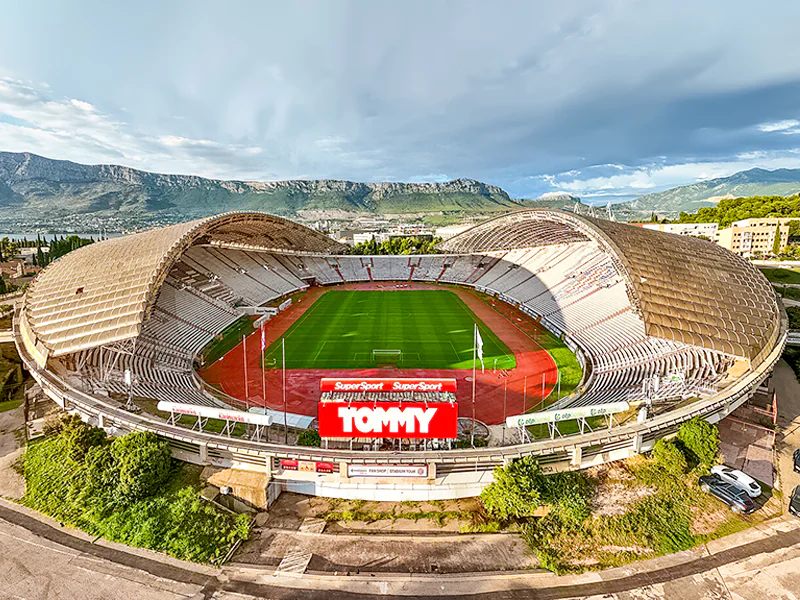
A new stadium could be built on the site of Croatian football team Hajduk Split’s current Poljud Stadium site after a study was carried out into various options for a new home for the club.
Croatia Week said the study concluded that building a new football stadium at Poljud is the most viable and financially sustainable solution for the future of football infrastructure in Split.
The analysis was prepared by consulting firm UHY Savjetovanje, with authors Krešimir Budiša and Boris Pekić presenting the findings.
Hrvatski Nogometni klub Hajduk Split, commonly referred to as Hajduk Split, is a Croatian professional football club based in Split, that competes in the Croatian Football League, the top tier in Croatian football. Since 1979, the club’s home ground has been the 33,987-seater Poljud Stadium.
The study examined four possible scenarios for the future of football infrastructure in Split.
The first option, at €391.4 million, proposes renovating and carrying out an energy upgrade of the existing Poljud Stadium, while simultaneously building a completely new stadium in the Brodarica area and a training camp in Stobreč.
Under this plan, the renovated Poljud would primarily become an athletics stadium used by ASK Split and RNK Split, while the new stadium would include underground parking and commercial facilities.
The second option involves upgrading and expanding the existing Poljud stadium itself. Estimated at €82.5 million, it is the fastest and least expensive option but does not include building a new stadium for Hajduk.
Plans include an additional structure on the western side of the stadium and expanded parking facilities, with completion potentially by 2030.
The third option, which the study ultimately identifies as the most favourable, involves constructing a new stadium on the Poljud site. The project is estimated at €316.1 million.
Under this model, Hajduk would continue playing at Poljud until 2029, after which the club would temporarily move to a reconstructed Park Mladeži Stadium.
The upgraded Park Mladeži venue would have capacity for around 10,700 spectators and meet UEFA standards. By 2032, Split would therefore have two renovated stadiums meeting UEFA requirements.
The fourth option considers building a new stadium on an as-yet undefined location on the city’s outskirts. This would include approximately 7,000 parking spaces and organised public transport access.
However, with a projected cost of €577.7 million, this scenario would be the most expensive. Poljud would be converted for athletics use, and a training camp would also be built in Stobreč.
The study concluded that the third option, constructing a new stadium at Poljud alongside the reconstruction of Park Mladeži, offers the best balance between cost and long-term benefits.
The first and fourth options were assessed as financially unrealistic due to the significant burden they would place on the city budget. Meanwhile, the second option was considered only a short-term solution that largely maintains the current situation without addressing future infrastructure needs.
Mayor Tomislav Šuta said the study represents the first comprehensive professional analysis of stadium development possibilities in Split.
Šuta said, “After 50 years, the time has come for Split to get a new stadium. This is the first time the city has had such a thorough and professionally prepared document clearly outlining the realistic options for developing our football infrastructure.”
He added that the study clearly shows the construction of a new stadium at Poljud, combined with the reconstruction of Park Mladeži and the development of a training camp, as the most sustainable solution.
“The next phase is decision-making. We will also organise a consultative referendum so citizens can express their views on this important project,” he said.
For HNK Hajduk Split, the club’s leadership said any solution that leads to the construction of a new stadium would be welcomed.
Continue to follow Coliseum for latest updates on venues business news. Coliseum is dedicated towards building the best global community of sports and entertainment venue executives and professionals creating better and more profitable venues.
Become a member of the only Global Sports Venue Alliance and connect with stadiums, arenas and experts from around the world. Apply for membership at coliseum-online.com/alliance and make use of the 365Coliseum Business.